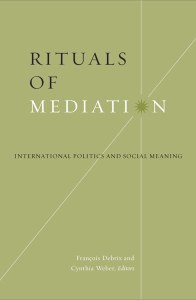
Rituals of Mediation
International Politics and Social Meaning
The authors consider international issues like security, development, political activism, and the war against terrorism through the lens of cultural practices such as traveling through airports, exhibiting art and photography, logging on to the Internet, and spinning news stories.
Contributors: Robin Brown, David Campbell, Michael Dillon, Debbie Lisle, Moya Lloyd, Timothy W. Luke, Patricia L. Price, Jayne Rodgers, Marysia Zalewski.
In an era of increasing globalization, the cultural and the international have borders as permeable as most nations’s—and an understanding of one requires making sense of the other. Foregrounding the role of mediation—understood here as a site of representation, transformation, and pluralization—the authors engage two specific questions: How might we make theoretical and practical sense of transnational cultural interactions? And how are we to understand the ways in which the sites of mediation represent, transform, and remediate internationals? Accordingly, the authors consider international issues like security, development, political activism, and the war against terrorism through the lens of cultural practices such as traveling through airports, exhibiting art and photography, logging on to the Internet, and spinning news stories.
Contributors: Robin Brown, U of Leeds; David Campbell, U of Newcastle upon Tyne; Michael Dillon, U of Lancaster; Debbie Lisle, Queen’s U, Belfast; Moya Lloyd, Queen’s U, Belfast; Timothy W. Luke, Virginia Polytechnic Institute and State U; Patricia L. Price, Florida International U; Jayne Rodgers, U of Leeds; Marysia Zalewski, Queen’s U, Belfast.
Contents
Preface François Debrix and Cynthia Weber
Acknowledgments
Introduction: Rituals of Mediation xxi François Debrix
PART I Sites of Mediation
ONE Site Specific: Medi(t)ations at the Airport Debbie Lisle
TWO Spatializing International Activism: Genetically Modified Foods on the Internet Jayne Rodgers
THREE Postcards from Aztlán Patricia L.Price
PART II Sights of Mediation
FOUR Salgado and the Sahel: Documentary Photography and the Imaging ofFamine David Campbell
FIVE Sensationally Mediated Moralities:Innocence,Purity,and Danger Moya Lloyd and Marysia Zalewski
SIX Site Improvements: Discovering Direct-Mail Retail as “B2C”Industrial Democracy Timothy W.Luke
PART III Mediation,Cultural Governance,and the Political
SEVEN Culture,Governance,and Global Biopolitics Michael Dillon
EIGHT Spinning the World:Spin Doctors,Mediation,and Foreign Policy Robin Brown
Epilogue:Romantic Mediations of September 11 Cynthia Weber
Contributors
Index