Region
Planning the Future of the Twin Cities
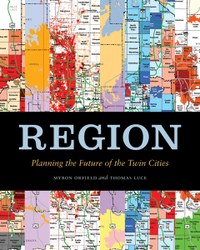
In Region Myron Orfield and Thomas Luce examine both the successes and shortcomings of the Twin Cities Metropolitan Council’s regional planning and policy. Throughout this detailed and deeply researched work, they analyze the wide impact of planning failures and the promise of successful growth, and ultimately put forth trenchant policy recommendations for a better future—one where we live up to our social, environmental, and political ideals.
Through their detailed analysis of the Twin Cities, Myron Orfield and Thomas Luce make a compelling case for a renewed commitment to regional planning and governance. As a central city mayor, I know that the issues my suburban colleagues and I face every day—poverty, unemployment, crime, social isolation—are rooted in our metropolitan context. Orfield and Luce confirm that the solutions we seek—and the healthy community we envision—depend on our collaboration around a regional agenda.
Christopher B. Coleman, Mayor, City of Saint Paul
The Twin Cities region contains 11 counties, 300 cities and townships, and 1,700 unique combinations of tax rates and public services. Historically, this fragmentation has made it extremely difficult to address the social, economic, and environmental problems that affect all parts of the region, yet the Minneapolis and St. Paul area has generally been held in high esteem as a model of regional cooperation. How do policy planners make it work—and is it working well enough?
In Region Myron Orfield and Thomas Luce examine both the successes and shortcomings of the Twin Cities Metropolitan Council’s regional planning and policy. Detailing the rapid demographic, commuting, and land use changes that are currently at work in the region, Orfield and Luce identify the new challenges faced by the cities and the suburbs and their overlooked interdependence. They thoroughly investigate the economic and political trends impacting Twin Cities residents’ quality of life—sprawl, population growth, economic and racial injustice, a lack of affordable housing, traffic congestion—and in particular how education demographic trends are solidifying segregation. Extensive maps, graphs, and charts accompany the authors’ argument for careful, coordinated regional development in the Twin Cities and explanations about how such an approach should be a model for other regions around the United States.
Confronting unsettling—sometimes shocking—realities of life in the Twin Cities, Orfield and Luce highlight the urgent need to create thriving integrated neighborhoods and job growth throughout the region, as well as the near impossibility of desegregating our neighborhoods and schools. Throughout this detailed and deeply researched work, they analyze the wide impact of planning failures and the promise of successful growth, and ultimately put forth trenchant policy recommendations for a better future—one where we live up to our social, environmental, and political ideals.
Through their detailed analysis of the Twin Cities, Myron Orfield and Thomas Luce make a compelling case for a renewed commitment to regional planning and governance. As a central city mayor, I know that the issues my suburban colleagues and I face every day—poverty, unemployment, crime, social isolation—are rooted in our metropolitan context. Orfield and Luce confirm that the solutions we seek—and the healthy community we envision—depend on our collaboration around a regional agenda.
Christopher B. Coleman, Mayor, City of Saint Paul
Once again, Myron Orfield has given us insight and guidance about how the policy decisions we make can determine the kind of communities we want to see.
Mayor R.T. Rybak, City of Minneapolis
This rich, granular, and highly visual perspective on growth dynamics in the Twin Cities metro is as timely as it is relevant. The book will inform and inspire efforts to remake metro governance and metro policy in the service of more sustainable, inclusive, and productive growth.
Bruce Katz, Vice President and Director, Metropolitan Policy Program, The Brookings Institution
This book, co-authored by metropolitan governance experts Myron Orfield and Thomas F. Luce, Jr. belongs on the desks of Minnesota policy enthusiasts everywhere. With its colorful maps showing racial and income disparities, and intriguing overlays featuring such factors as travel times and environmentally sensitive areas, the book also works well as a coffee-table conversation starter.
Growth and Justice Blog
While the subject is not new, this book provides much that is fresh in the way of detailing data in five policy areas: land-use planning, housing and schools, economic development and transportation, the environment, and governance.
Planning Magazine