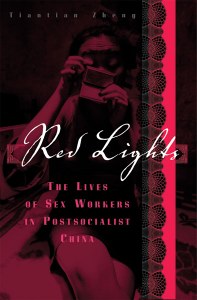
Red Lights
The Lives of Sex Workers in Postsocialist China
In China today, sex work cannot be untangled from the phenomenon of rural–urban migration, the entertainment industry, and state power. In Red Lights, Tiantian Zheng highlights the urban karaoke bar as the locus at which these three factors intersect and provides a rich account of the lives of karaoke hostesses—a career whose name disguises the sex work and minimizes the surprising influence these women often have as power brokers.
Trenchant and moving, Tiantian Zheng’s book sheds much light upon emerging social hierarchies in urban China, the subterranean world of doing business in China today, and the cruelties and corruption entailed therein.
Dorothy J. Solinger, University of California, Irvine
In China today, sex work cannot be untangled from the phenomenon of rural–urban migration, the entertainment industry, and state power. In Red Lights, Tiantian Zheng highlights the urban karaoke bar as the locus at which these three factors intersect and provides a rich account of the lives of karaoke hostesses—a career whose name disguises the sex work and minimizes the surprising influence these women often have as power brokers.
Zheng embarked on two years of intensely embedded ethnographic fieldwork in her birthplace, Dalian, a large northeastern Chinese seaport of over six million people. During this time, Zheng lived and worked with a group of hostesses in a karaoke bar, facing many of the same dangers that they did and forming strong, intimate bonds with them. The result is an especially engaging, moving story of young, rural women struggling to find meaning, develop a modern and autonomous identity, and, ultimately, survive within an oppressively patriarchal state system.
Moving from her case studies to broader theories of sex, gender, and power, Zheng connects a growth in capitalist entrepreneurialism to the emergence of an urban sex industry, brilliantly illuminating the ways in which hostesses, their clients, and the state are mutually created in postsocialist China.
Awards
2010 Sara A. Whaley Book Prize
Trenchant and moving, Tiantian Zheng’s book sheds much light upon emerging social hierarchies in urban China, the subterranean world of doing business in China today, and the cruelties and corruption entailed therein.
Dorothy J. Solinger, University of California, Irvine
A richly detailed and engaged ethnography, Red Lights is both a fascinating read and a major contribution to a nuanced analysis of the cultural politics of gender, sex, social class, and power in rapidly transforming societies.
Li Zhang, University of California at Davis
Zheng participated in activities that male ethnographers could only have observed. Her analysis of sexual networking is consequently first-rate because she moves easily and persuasively from person to state, capital to labor, ideology to practice. It is a major contribution to ethnographic explorations of gender, sexuality, and prostitution, and to Asian Studies, too, which has enabled too few particular observation-style studies of sexual networking.
Feminist Review
There is no better work on the subject in English or Chinese, providing an insightful and highly readable scholarly account of one corner of what is already perhaps the largest commercial sex industry in the world.
The China Journal
The first-hand nature of the investigation provides unprecedented insight into the world of karaoke bars. The result is a rich description and analysis of an important institution in postsocialist China.
Labour/Le Travail
A fresh and engaging account of the lives of migrant workers in the sex industry. Zheng’s detailed reflection on her ethnographic approach captures the emotions and the dynamic interactions between the researcher and the subjects of her study, adding a personal touch.
Journal of Asian Studies
A richly informed analysis. Red Lights offers a finely nuanced study of the uneven development in postsocialist China.
Signs
Ethnographically, Red Lights is extremely rich and provides the reader with a lens into the karaoke bar that has previously not been available to outsiders. This is an extremely important addition to the literature on gender, sexuality, and transition in post-Mao China.
American Ethnologist
The author’s ethnographic fieldwork yields powerful insights into the physical, spatial, and sensory worlds of her subjects.
China Information
Zheng’s work joins a growing band of well researched feminist ethnographies of the international sex work scene – notably the work of Julia O’Connell Davidson and as an ethnography of migrant sex workers in China, this study seems to this reviewer to be a first; a must read.
Sexualities
This book makes significant contributions to the study of gender issues in Asian studies. It demonstrates solid scholarship in attempting to explore the relationship among sex workers, clients, and the state. Thus, it deserves wide attention by Western scholars.
China Review International
Red Lights is an intricately and trenchantly argued ethnographic study of female sex workers in Dailan. . . Zheng combines the tenacity of a skilled ethnographer and the elegant diction of a poet.
Asian Ethnology