Recording Reality, Desiring the Real
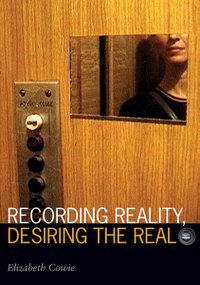
Recording Reality, Desiring the Real shows how documentary has been simultaneously understood as factual, as story, as art, and as political. Elizabeth Cowie stakes documentary’s central place in cinema as both an art form and a form of social engagement, addressing the seeming paradox between the pleasures of spectacle in the documentary and its project of informing and educating.
Elizabeth Cowie brings her keen analytical intelligence to bear in addressing the paradoxes of documentary. She demonstrates how the theoretically informed analysis of the history of documentary has become even more crucial in the light of its recent modes of incarnation in reality television, news/catastrophe reporting, and the public display of personal, seemingly mundane, everyday details on the Internet. This is an intricate and powerful treatment of our psychical investment in the representation of the real that will certainly have a major impact on our thinking about documentary.
Mary Anne Doane, Brown University
Documentary has once again emerged as one of the most vital cultural forms, whether seen in cinemas or inside the home, as digital, film, or video. In Recording Reality, Desiring the Real, Elizabeth Cowie looks at the history of documentary and its contemporary forms, showing how it has been simultaneously understood as factual, as story, as art, and as political, addressing the seeming paradox between the pleasures of spectacle in the documentary and its project of informing and educating.
Cowie claims that, as a radical film form, documentary has been a way for filmmakers to acknowledge historical and contemporary realities by presenting images of these realities. If documentary is the desire to know reality through its images and sounds, she asks, what kind of speaking (and speaking about) emerges in documentary, and how are we engaged by it? In considering this and other questions, Cowie examines a range of noteworthy films, including Spike Lee’s When the Levees Broke, John Huston’s Let There Be Light, and Milica Tomić’s Portrait of My Mother.
Recording Reality, Desiring the Real stakes documentary’s central place in cinema as both an art form and a form of social engagement, which together create a new understanding of spectatorship.
Elizabeth Cowie brings her keen analytical intelligence to bear in addressing the paradoxes of documentary. She demonstrates how the theoretically informed analysis of the history of documentary has become even more crucial in the light of its recent modes of incarnation in reality television, news/catastrophe reporting, and the public display of personal, seemingly mundane, everyday details on the Internet. This is an intricate and powerful treatment of our psychical investment in the representation of the real that will certainly have a major impact on our thinking about documentary.
Mary Anne Doane, Brown University
It is perceptive and provocative.
Jump Cut
Recording Reality, Desiring the Real is both timely and relevant. This book shine when periodically referencing insightful historical points of origins of the documentary.
documentary.org
Recording Reality, Desiring the Real takes us beyond the contexts, issues, and ‘messages’ of documentary ‘evidence’ to reveal how documentaries construct their realities, work as experiences, function aesthetically and culturally, reflect and engage the world around us.
New Formations
The new book offers a consistent psychoanalytical theorization of the genre, a move that one has to still consider as groundbreaking. Cowie, using the thought of Derrida and Zizek as well as Bakhtin and other theorists, offers an in-depth analysis of the relationship between time and space in a documentary film.
Intellect Journal
Cowie’s theoretical exploration of the many paradoxical components of documentaries and documentary spectatorship in Recording Reality, Desiring the Real stands out as a major contribution to film studies.
Alphaville: Journal of Film and Screen Media
Recording Reality, Desiring the Real makes an important contribution to the applications of psychoanalytic and other cultural theories on the foundational questions of documentary.
International Journal of Communication
Acknowledgments
Introduction: The Spectacle of Actuality and the Desire for Reality
1. Narrating the Real: The Fiction and the Nonfiction of Documentary Storytelling
2. Working Images: Representing Work and Voicing the Ordinary
3. Documentary Desire: Seeing for Ourselves and Identifying in Reality
4. Documenting the Real
5. Ways of Seeing and the Surreal of Reality
6. Specters of the Real: Documentary Time and Art
Notes
Index