Ottoman Izmir
The Rise of a Cosmopolitan Port, 1840-1880
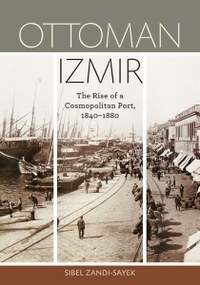
Ottoman Izmir examines how urban space, institutional structures, and everyday practices shaped one another in the thriving Eastern Mediterranean seaport of Izmir between 1840 and 1880. Sibel Zandi-Sayek investigates local populations who were actively engaged in restructuring the city and shows how Izmir’s various stakeholders contested its built environment, offering a new view of the dynamics of urban modernization.
Late Ottoman Izmir provides a fascinating case study for Sibel Zandi-Sayek’s book. Her analysis of the physical settings and her use of architecture and urban forms as primary documents to understand the social fabric make her approach particularly intriguing.
Zeynep Celik, Distinguished Professor, New Jersey Institute of Technology
Between 1840 and 1880, the Eastern Mediterranean port of Izmir (Smyrna) underwent unprecedented change. A modern harbor that welcomed international steamships and new railway lines that transported a cornucopia of products transformed the physical city. Migrants, seasonal workers, and transient sailors thronged into an already diverse metropolis, helping to double the population to 200,000. Simultaneously, Ottoman officials and enterprising citizens vied to control and reform the city’s administrative and legal institutions.
Ottoman Izmir examines how urban space, institutional structures, and everyday practices shaped one another in the thriving seaport of Izmir during a volatile period of growth. Sibel Zandi-Sayek investigates a variety of urban actors—Muslims and non-Muslims, Ottomans and Europeans, newcomers and native residents, merchants, investors, civil servants, and press reporters—who were actively engaged in restructuring the city. Concentrating on the workings of urban committees and on laws and policies that were written, rewritten, but never fully implemented, Zandi-Sayek exposes how modern interventions sought to impose clear-cut concepts of public and private, safety and danger, and hygiene on a city that previously had a wide range of customary regulations.
Ottoman Izmir shows how Izmir’s various stakeholders contested its built environment. In so doing, it offers a new view of the dynamics of urban modernization.
Awards
Co-winner of the 2013 M. F. Köprülü Prize from the Turkish Studies Association
Late Ottoman Izmir provides a fascinating case study for Sibel Zandi-Sayek’s book. Her analysis of the physical settings and her use of architecture and urban forms as primary documents to understand the social fabric make her approach particularly intriguing.
Zeynep Celik, Distinguished Professor, New Jersey Institute of Technology
Reveals an urban landscape of plurality and fluid boundaries juxtaposed with growing Ottoman state bureaucracy and intersecting and changing group interests.
Middle East Journal
What sets this book apart from usual urban social history is that Sibel Zandi-Sayek imbricates the social and political processes of modernization with the material developments of urban planning. The city is not merely a stage, or a theater for modernization: it is the stage, the theater, and importantly, also the actor and the audience.
Journal of Historical Geography
An extremely valuable and rewarding account of the social and cultural milieu and built environment of mid-19th century Izmir, an account all the more poignant for the catastrophe of 1922.
Journal of Turkish Weekly
Ottoman Izmir is an original and thought-provoking contribution to the growing literature on the urban history of the Eastern Mediterranean region.
International Journal of Turkish Studies
Zandi-Sayek’s detailed analysis of the transformation of the city of Izmir is an important work that scrutinizes not only the modernization of the said city, but also the complex process of modernization itself.
Domes: Digest of Middle East Studies
A rewarding example of a cultural approach to urban history.
Journal of Transport History
Articulate and engaging, Zandi-Sayek’s narrative captures the panorama of inter-communal relations in broad brushstrokes, while carefully constructing the details of everyday life, as the various socio-ethnic groups converged and diverged, reflecting the region’s mercurial political climate.
Insight Turkey
An eloquently written, well argued, and well researched book that does justice to a complex subject. A lasting contribution both to Ottoman studies and to the wider field of nineteenth-century urban change.
Journal of Modern History
This book is an exciting addition to the literature of the modernization of world cities.
Journal of Historical Geography
Contents
Author’s Note
Introduction: A World in Flux
1. Defining Citizenship: Property, Taxation, and Sovereignty
2. Ordering the Streets: Public Space and Urban Governance
3. Shaping the Waterfront: Public Works and the Public Good
4. Performing Community: Rituals and Identity
Epilogue: The View from Izmir
Acknowledgments
Notes
Bibliography
Index