Metropolitan Lovers
The Homosexuality of Cities
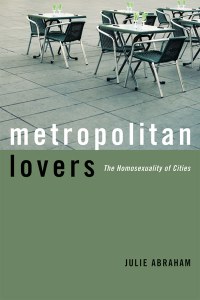
From the destruction of Sodom to the selling of Gay Street and from Tales of the City to The L Word, urban life and homosexuality have been made inseparable in Western culture. In this sweeping work, Julie Abraham investigates the evolution of this symbiotic relationship over the past two centuries, tracing how homosexuals have simultaneously become model citizens of the modern city and avatars of the urban.
Metropolitan Lovers grabbed my attention immediately and held it to the final page. The argument of the book is powerful, compelling, and original; the breadth of what Abraham covers is impressive; and individual insights are stunning. She made me understand the deep connections between cities and sexuality in dramatically new ways.
John D'Emilio, author of Intimate Matters: A History of Sexuality in America
From the destruction of Sodom to the selling of Gay Street and from Tales of the City to The L Word, urban life and homosexuality have been made inseparable in Western culture. In this sweeping work, Julie Abraham investigates the evolution of this symbiotic relationship over the past two centuries, tracing how homosexuals have simultaneously become model citizens of the modern city and avatars of the urban.
Exploring the lives of prominent gay men and women, literary depictions of gay city life, classic works of urban theory, and the rhetoric of political reformers, Abraham challenges conventional thinking about what it means to be metropolitan and what it means to be queer. She provocatively juxtaposes works from writers such as Balzac and Baudelaire, Henry James and James Baldwin, Walter Benjamin and Jane Jacobs to redefine such familiar urban types as the flaneur, the prostitute, and the drag queen. From Paris, London, and Manchester, to Los Angeles, Chicago, New York, and San Francisco, Abraham deftly maps the connections, the exchanges of meaning, and the transfers of value that inform ideas of homosexuality and the city, ideas that have shaped modern life. Bringing this history to bear on the present, she argues against the commodification of gay urbanites as contemporary signs of city life.
While the city and homosexuality have long been associated, Abraham analyzes their convergence with unprecedented insight. In the process, she shows us how the urban and homosexuality have been intertwined and the inescapable consequences—both positive and negative—of this union.
Metropolitan Lovers grabbed my attention immediately and held it to the final page. The argument of the book is powerful, compelling, and original; the breadth of what Abraham covers is impressive; and individual insights are stunning. She made me understand the deep connections between cities and sexuality in dramatically new ways.
John D'Emilio, author of Intimate Matters: A History of Sexuality in America
Bolstered by expertise, balance and solid reporting, this sociological report is a solid addition to any GLBT studies library.
Publishers Weekly
Those of us living in the Twin Cities know just how integral the GLBT community is to a metropolitan center. But Abraham, Professor of Literature and GLBT Studies at Sarah Lawrence College, clearly and readably develops her theme for those who might not have looked at city life from this perspective.
Lavender
Metropolitan Lovers is an enjoyable account of the relationship between homosexuality and metropolitan space and provides a wealth of knowledge for anyone who is interested in gender, urban, or cultural studies.
Journal of Cultural Geography
Abraham’s story of homosexuals and cities continues to shape the past and the future, but its deep resonance resides in its ability to trouble and question readers’ present relationships to cities and their own sexual identity.
Lamdaliterary.org
Using mostly literary sources and sociologists’ and journalists’ writings (along with a smidgen of sexologists’ and gay and anti gay activists’ works, and movies), Abraham provides an insightful cultural history of the relation between big cities and homosexuality, from European cities in the early 19th century to the contemporary US.
Choice
Julie Abraham’s Metropolitan Lovers offers a sophisticated treatment of the relationship between homosexuality and urban space that is both historically situated and still relevant to the present.
Journal of Urban History