Latin American Identity and Constructions of Difference
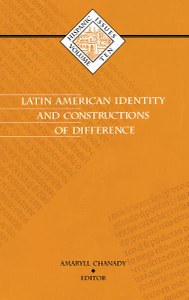
Takes a new look at Latin American identity, viewing it as a hybrid and heterogeneous cultural construction, characterized by problems specific to postcolonial societies. In contrast to previous works on the subject, this volume situates itself within the context of the most recent American and European literary and cultural theories, and makes a significant contribution to current debates over ideas of identity, postcolonialism, the marginalization of the Other, and postmodernism.
Notions of identity and difference, so much a matter of contention in cultural studies today, have long been central to Latin American critical thought. The authors represented here take a new look at Latin American identity, viewing it as a hybrid and heterogeneous cultural construction, characterized by problems specific to postcolonial societies. In contrast to previous works on the subject, this volume situates itself within the context of the most recent American and European literary and cultural theories, and thus makes a significant contribution to current debates over ideas of identity, postcolonialism, the marginalization of the Other, and even postmodernism.
Written by a philosopher, literary and cultural critics, and an anthropologist, the essays in this volume are truly interdisciplinary, offering the breadth of perspective that complex issues such as identity construction and postcolonialism demand and yet rarely receive. The diverse approaches and problems presented here coalesce around a central purpose: to subject several theoretical concepts, critical paradigms, and cultural constructs to rigorous critical analysis. Throughout the volume, the authors consider the position and construction of Latin American identity with respect to Eurocentric archetypes, including postmodernism and poststructuralist deconstruction. Such metropolitan frameworks, developed in an industrialized society, are exposed here in their complex, problematic relation to a cultural identity that predates their assumptions and applications.
The marginalization of Latin American philosophical discourse by the European institution, the application of European narratological categories to Latin American novels, and the reappraisal of Aztec reflexive abstract thought in the context of the conquest of Mexico are among the issues taken up by the authors in this volume. Together, they comprise a thorough and consistently critical discussion of one of the most contested topics in contemporary cultural studies. They will inform and shape the debate over identity, particularly the construction of Latin American identity, for years to come.