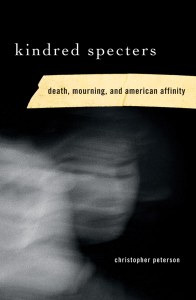
Kindred Specters
Death, Mourning, and American Affinity
Probing Derrida’s notion of spectrality as well as Orlando Patterson’s concept of “social death,” Christopher Peterson examines how death, mourning, and violence condition all kinship relations. Tracing the connections between kinship and mourning in American literature and culture, Peterson argues that socially dead “others” can be reanimated only if we avow the mortality and mourning that lie at the root of all kinship relations.
Kindred Specters speaks powerfully to African American and African Diasporic studies as well as kinship studies, not just building on them but breaking new ground and providing new insight.
Michelle M. Wright, author of Becoming Black: Creating Identity in the African Diaspora
The refusal to recognize kinship relations among slaves, interracial couples, and same-sex partners is steeped in historical and cultural taboos. In Kindred Specters, Christopher Peterson explores the ways in which nonnormative relationships bear the stigma of death that American culture vehemently denies.
Probing Derrida’s notion of spectrality as well as Orlando Patterson’s concept of “social death,” Peterson examines how death, mourning, and violence condition all kinship relations. Through Charles Chesnutt’s The Conjure Woman, Peterson lays bare concepts of self-possession and dispossession. He reads Toni Morrison’s Beloved against accounts of ethics, kinship, and violence in order to ask what it means to claim one’s kin as property. Using William Faulkner’s Absalom, Absalom! he considers the implications of comparing bans on miscegenation and gay marriage.
Tracing the connections between kinship and mourning in American literature and culture, Peterson demonstrates how racial, sexual, and gender minorities often resist their social death by adopting patterns of affinity that are strikingly similar to those that govern normative relationships. He concludes that socially dead “others” can be reanimated only if we avow the mortality and mourning that lie at the root of all kinship relations.
Kindred Specters speaks powerfully to African American and African Diasporic studies as well as kinship studies, not just building on them but breaking new ground and providing new insight.
Michelle M. Wright, author of Becoming Black: Creating Identity in the African Diaspora
Kindred Specters is a thought-provoking and rewarding philosophical discussion.
Midwest Book Review
The book offers a very important insight into the study of the conjuncture of kinship, death, and mourning. It also asks important questions about the future of queer studies on kinship, one that overcomes the constant reproduction of elisions(s) of mainstream culture.
Nordic Journal of Feminist and Gender Research
Christopher Peterson’s Kindred Specters: Death, Mourning, and American Affinity
is an impressive study of the politics of loss in American culture. Kindred Specters is a smart, forcefully argued book; Peterson’s nuanced and provocative arguments and deft analyses shed new light on both canonical texts and pressing political questions. The book’s critical lens
admirably illuminates key moments in the much-discussed narratives.
Modern Philology