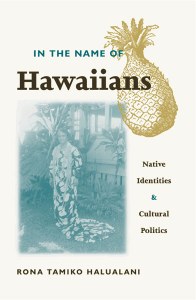
In the Name of Hawaiians
Native Identities and Cultural Politics
Rona Tamiko Halualani analyzes the diverse formations and practices of Hawaiian identity and sociality, on the U.S. mainland as well as on the islands. Halualani shows how larger forces from different historical moments changed the social relations surrounding Hawaiians, the ways in which they have been identified, and how they make sense of who they are. Throughout she interweaves the countering narratives and practices by indigenous Hawaiians as they seek authorization of their identities, land rights, and culture.
In the Name of Hawaiians is intensely and intellectually passionate and engaged, Halualani provides a theoretically sophisticated and nuanced discussion of Hawaiian identity practices.
Wendy Ho, author of In Her Mother's House: The Politics of Asian American Mother-Daughter Writing
Deep within the historical imagination, there lies the image of a Western explorer surrounded by dark and strange natives. In the modern and postmodern spaces of tourism, one finds the reflections of an antiquated nativism that is already dead, however commercially viable. And in the statutes of the State of Hawai‘i, the Aloha spirit is codified into the ideology of multiculturalism. Where, among the multiple representations and constructions of what is "Hawaiian," is Hawaiian identity actually lived?
Rona Tamiko Halualani analyzes the diverse formations and practices of Hawaiian identity and sociality, on the U.S. mainland as well as on the islands, across several interrelated contexts: museum culture, explorer journals, maps, tourism, census technology, blood quantum mandates, neocolonial administration, and lived community practice. Halualani shows how these contexts represent larger forces from different historical moments that significantly changed the social relations surrounding Hawaiians, the ways in which they have been identified, and how they make sense of who they are. Throughout she interweaves the countering narratives and practices by indigenous Hawaiians as they seek authorization of their identities, land rights, and culture.
In the Name of Hawaiians is intensely and intellectually passionate and engaged, Halualani provides a theoretically sophisticated and nuanced discussion of Hawaiian identity practices.
Wendy Ho, author of In Her Mother's House: The Politics of Asian American Mother-Daughter Writing
Contents
Acknowledgments
Glossary of Hawaiian Words
Introduction: The Legacy of Identity
1.Abstract Nativism and the Historical Imagination
2.Racialized Natives and White Citizenship
3.Exposing the Racial State: Blood Quantum and Private Memories
4.From Queens to Calabashes: Touring the Native
5.Little Bit Blood, Heart, and Spectacle: Practicing Hawaiian Memory and Community in the Diaspora
Afterword: Identity Legacies and Challenges
Notes
Bibliography
Index