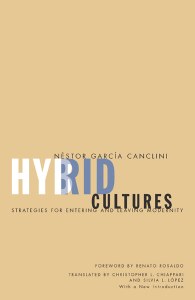
Hybrid Cultures
Strategies for Entering and Leaving Modernity
This book displays some of the most provocative ideas in the field of cultural studies and offers important lessons for educators. It is a well-researched, rigorous, and well-written book, and for these reasons, the Latin American Studies Association declared Hybrid Cultures the best book written about Latin America in Spanish of 1991-92.
Comparative Education Review
When it was originally published in 1995, Hybrid Cultures was foundational to Latin American cultural studies. This now-classic work features a new introduction in which Néstor García Canclini calls for a cultural politics to contain the damaging effects of globalization and responds to theoretical developments over the past decade.
García Canclini questions whether Latin America can compete in a global marketplace without losing its cultural identity. He moves with ease from the ideas of Gramsci and Foucault to economic analysis, from appraisals of the exchanges between Octavio Paz and Jorge Luis Borges to Chicano film and graffiti. Hybrid Cultures at once clarifies the development of democratic institutions in Latin America and reveals that the most destructive ideological trends are still going strong.
This book displays some of the most provocative ideas in the field of cultural studies and offers important lessons for educators. It is a well-researched, rigorous, and well-written book, and for these reasons, the Latin American Studies Association declared Hybrid Cultures the best book written about Latin America in Spanish of 1991-92.
Comparative Education Review
Anyone wanting to begin to achieve this understanding will benefit greatly from entering Nestor Garcia Canclini’s Hybrid Cultures, be it by land, sea or air.
Elizabeth Fox, Media and Development
A rare combination of breadth and detail is brought to bear on the relations between tradition and modernity, and between local cultural phenomena and globalizing forces. The author’s cultural and theoretical range is extraordinary.
Bulletin of Latin American Research
Garcia Canclini is a fine thinker and what he writes has been seriously thought through.
Year’s Work in Critical and Cultural Theory
Contents
Foreword Renato Rosaldo
Acknowledgments
Introduction: Hybrid Cultures in Globalized Times
Entrance
1 From Utopias to the Market
2 Latin American Contradictions: Modernism without Modernization?
3 Artists, Middlemen, and the Public: To Innovate or to Democratize?
4 The Future of the Past
5 The Staging of the Popular
6 The Popular and Popularity: From Political to Theatrical Representation
7 Hybrid Cultures, Oblique Powers
Exit
Bibliography
Index