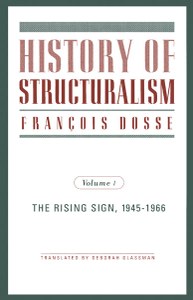
History of Structuralism
Volume 1
François Dosse
Translated by Deborah Glassman
The first comprehensive history of one of the most influential intellectual movements of the twentieth century.
The ideas of the French intellectuals who propounded structuralism and poststructuralism have had a profound impact on disciplines ranging from literary theory to sociology, from anthropology to philosophy, from history to psychoanalysis. A long-awaited translation, this two-volume set examines the thinkers who made up the movement, providing a fascinating elucidation of a central aspect of postwar intellectual history. “Dosse’s work is exceptional in its pursuit of an honest and relevant archaeology that not only clarifies the past but offers lessons for the future.” --Libération
“The most striking aspect of Dosse’s project is what Clément (1996: 8) justly calls its ‘monumental’ nature, the sheer comprehensiveness and encyclopaedic character of the nearly 1000-page undertaking. Dosse brings together and meticulously dissects a bewildering number of strands of thought which loosely formed the structuralist edifice; the analysis of key thinkers who enjoy a lesser renown in the English-speaking world (Benveniste, Canguilhem, Dumézil, Greimas, etc.) is particularly useful. Hence, biographical, historical and theoretical dimensions are impressively woven together into a whole that avoids a banal dictionary format or facile psychologism.” Thesis Eleven
Claude Lévi-Strauss, Roland Barthes, Jacques Lacan, Louis Althusser, Jacques Derrida, and Michel Foucault—the ideas of this group of French intellectuals who propounded structuralism and poststructuralism have had a profound impact on disciplines ranging from literary theory to sociology, from anthropology to philosophy, from history to psychoanalysis. In this long-awaited translation, History of Structuralism examines the thinkers who made up the movement, providing a fascinating elucidation of a central aspect of postwar intellectual history.
François Dosse tells the story of structuralism from its beginnings in postwar Paris, a city dominated by the towering figure of Jean-Paul Sartre. The work of Saussure became the point of departure for a group of younger scholars, and the outcome was not only the doom of Sartre as intellectual leader but the birth of a movement that would come to reconfigure French intellectual life and would eventually reverberate throughout the Western world.
Dosse provides a readable, intelligible overall account, one that shows the interrelationship among the central currents of structuralism and situates them in context. Dosse illuminates the way developments in what are usually distinct fields came to exert such influence on each other, showing how the early structuralists paved the way for later developments and for recent discourses such as postmodernism. The cast of characters related by Dosse includes those mentioned above as well as Roman Jakobson, Julia Kristeva, Pierre Bourdieu, Gilles Deleuze, Félix Guattari, Tzvetan Todorov, and many others. Chapters are devoted to major figures, and Dosse has done extensive interviews with the major and minor figures of the movement, furnishing an intellectual history in which historical players look back at the period.
This first comprehensive history of the structuralist movement is an essential guide to a major moment in the development of twentieth-century thought, one that provides a cogent map to a dizzying array of personalities and their ideas. It will be compelling reading for those interested in philosophy, literary theory, sociology, anthropology, linguistics, and psychoanalysis.
$33.00 paper ISBN 978-0-8166-2371-6
534 pages, 20 b&w photos, 5 7/8 x 9, 1998
François Dosse is also the author of The Empire of Meaning: The Humanization of the Social Sciences, forthcoming from Minnesota.
Deborah Glassman is director of the Paris Center for Critical Studies and is the author of Marguerite Duras: Fascinating Vision and Narrative Cure (1991).
François Dosse is also the author of The Empire of Meaning: The Humanization of the Social Sciences, forthcoming from Minnesota.
Deborah Glassman is director of the Paris Center for Critical Studies and is the author of Marguerite Duras: Fascinating Vision and Narrative Cure (1991).
“The most striking aspect of Dosse’s project is what Clément (1996: 8) justly calls its ‘monumental’ nature, the sheer comprehensiveness and encyclopaedic character of the nearly 1000-page undertaking. Dosse brings together and meticulously dissects a bewildering number of strands of thought which loosely formed the structuralist edifice; the analysis of key thinkers who enjoy a lesser renown in the English-speaking world (Benveniste, Canguilhem, Dumézil, Greimas, etc.) is particularly useful. Hence, biographical, historical and theoretical dimensions are impressively woven together into a whole that avoids a banal dictionary format or facile psychologism.” Thesis Eleven
“Excellent. . . . Dosse reminds us that not only was Structuralism an intellectual event of the sixties, it was also the cultural coup d’état that both put an end to the reign of Sartre and existentialism and inaugurated the rise of the humanities.” Le Figaro
“Dosse’s work is exceptional in its pursuit of an honest and relevant archaeology that not only clarifies the past but offers lessons for the future.” Liberation
“Chronicles with superb documentation the development of the structuralist movement as it was propelled by such forces as Claude Levi-Strauss, Jacques Lacan, Michel Foucault, and many other French social scientists and humanists.” Library Journal
“Believe it or not, this two-volume, 975-page history of French structuralism, originally published in French in 1991-1992 and based on interviews with some 123 French academics and intellectuals, reads like a good novel. Once you pick it up, it is hard to put Dosse’s History down.” Postmodern Culture
“This is a comprehensive history of what Dosse frames as the unprecedented rise and fall of an intellectual movement that transformed the way we consider human society.” Choice
Excellent. . . . Dosse reminds us that not only was Structuralism an intellectual event of the sixties, it was also the cultural coup d’état that both put an end to the reign of Sartre and existentialism and inaugurated the rise of the humanities.
Le Figaro
Dosse’s work is exceptional in its pursuit of an honest and relevant archaeology that not only clarifies the past but offers lessons for the future.
Liberation
Chronicles with superb documentation the development of the structualist movement as it was propelled by such forces as Claude Levi-Strauss, Jacques Lacan, Michel Foucault, and many other French social scientists and humanists.
Library Journal
Believe it or not, this two-volume, 975-page history of French structuralism, originally published in French in 1991-1992 and based on interviews with some 123 French academics and intellectuals, reads like a good novel. Once you pick it up, it is hard to put Dosse’s History down.
Postmodern Culture
This is a comprehensive history of what Dosse frames as the unprecedented rise and fall of an intellectual movement that transformed the way we consider human society.
Choice
The most striking aspect of Dosse’s project is what Clément (1996: 8) justly calls its ‘monumental’ nature, the sheer comprehensiveness and encyclopaedic character of the nearly 1000-page undertaking. Dosse brings together and meticulously dissects a bewildering number of strands of thought which loosely formed the structuralist edifice; the analysis of key thinkers who enjoy a lesser renown in the English-speaking world (Benveniste, Canguilhem, Dumézil, Greimas, etc.) is particularly useful. Hence, biographical, historical and theoretical dimensions are impressively woven together into a whole that avoids a banal dictionary format or facile psychologism.
Thesis Eleven
Dosse’s History of Structuralism is intellectual history at its best. Dosse tells the story of how a new generation of young Parisian intellectuals, profoundly influenced by the structuralist anthropologist Claude Lévi-Strauss, and by psychoanalyst Jacques Lacan, first challenged the intellectual hegemony of Sartre in the late 1950s and early ‘60s, and how structuralism came to displace a philosophical discourse in which the autonomous subject shaped his or her own world. Those looking for a clear and lucid guide through the maze of structuralist and post-structuralist theories and ideas, as well as the broader cultural forces that have shaped them, will do well to read these two impressive volumes.
Bridges
About This Book
Related Publications
French Theory
How Foucault, Derrida, Deleuze, & Co. Transformed the Intellectual Life of the United States
The must-read exposé of America’s love/hate affair with French theory
Empire of Meaning
The Humanization of the Social Sciences
An essential guide to Continental philosophy after structuralism.