Haunting the Korean Diaspora
Shame, Secrecy, and the Forgotten War
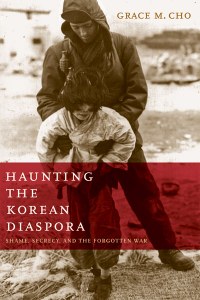
Through intellectual vigor, Haunting the Korean Diaspora explores the repressed history of emotional and physical violence between the United States and Korea and the unexamined reverberations of sexual relationships between Korean women and American soldiers.
At once political and deeply personal, Cho’s analysis of U.S. neocolonialism and militarism under contemporary globalization brings forth a new way of understanding—and remembering—the impact of the Korean War.
A work of scholarship, an act of memory, a cultural history, and an experiment in writing and intellectual politics, Haunting the Korean Diaspora is an ambitious—in the best sense of that word—and poetic foray into unraveling the knotted silences of a traumatized history.
Jackie Orr, Syracuse University
Since the Korean War—the forgotten war—more than a million Korean women have acted as sex workers for U.S. servicemen. More than 100,000 women married GIs and moved to the United States. Through intellectual vigor and personal recollection, Haunting the Korean Diaspora explores the repressed history of emotional and physical violence between the United States and Korea and the unexamined reverberations of sexual relationships between Korean women and American soldiers.
Grace M. Cho exposes how Koreans in the United States have been profoundly affected by the forgotten war and uncovers the silences and secrets that still surround it, arguing that trauma memories have been passed unconsciously through a process psychoanalysts call “transgenerational haunting.” Tracing how such secrets have turned into “ghosts,” Cho investigates the mythic figure of the yanggongju, literally the “Western princess,” who provides sexual favors to American military personnel. She reveals how this figure haunts both the intimate realm of memory and public discourse, in which narratives of U.S. benevolence abroad and assimilation of immigrants at home go unchallenged. Memories of U.S. violence, Cho writes, threaten to undo these narratives—and so they have been rendered unspeakable.
At once political and deeply personal, Cho’s wide-ranging and innovative analysis of U.S. neocolonialism and militarism under contemporary globalization brings forth a new way of understanding—and remembering—the impact of the Korean War.
Awards
American Sociological Association – 2009 Asia & Asian America Section Book Award
A work of scholarship, an act of memory, a cultural history, and an experiment in writing and intellectual politics, Haunting the Korean Diaspora is an ambitious—in the best sense of that word—and poetic foray into unraveling the knotted silences of a traumatized history.
Jackie Orr, Syracuse University
This stunning book defies categorization. Grace M. Cho conjures forth an accumulated history of disavowed kinship and hidden grief overshadowing Korean partition and diaspora. This brilliant diasporic vision unfolds upon a traumatic terrain of ghosts, implicating along their silent pathways not only an unacknowledged history of military and political abuse but also the everyday business of knowledge production in the social sciences.
David L. Eng, University of Pennsylvania
Korean American sociologist Cho understands the sociological imagination. She untangles a web of Korean sex workers’ biographies within the wider historical, political, and social contexts that have influenced them, Korean, and the U.S. Her book is a catharsis for a traumatically muted history.
Choice
It’s the human consequences that Cho most aims to detail—lovingly, with respect and lamentation.
Women’s Review of Books
Grace M. Cho’s book, Haunting the Korean Diaspora: Shame, Secrecy, and the Forgotten War, is innovative in its methodology and arresting in content and analysis.
Women’s Studies Quarterly
Haunting the Korean Diaspora artfully interweaves psychoanalytic and critical discourses on a number of traumatic political and social events in modern Korean history.
Asian Ethnology
Cho’s intensely personal and political study is a unique and important contribution to Korean and Korean American studies as there are still very few accounts and analyses of civilians that survived the Korean War and its aftermath and how their experiences consciously and unconsciously permeate the Korean diaspora in the United States.
Journal of World History
An intriguingly unorthodox book that mixes scholarship and personal experience in ways rarely seen in traditional productions of those in academia. Haunting the Korean Diaspora is challenging and enlightening.
Journal of International and Global Studies
Grace Cho’s robust analysis of creative works, as well as interviews gleaned from already published secondary sources . . . should be applauded.
Journal of American Ethnic History
This ground breaking, beautifully written book explores the painful and unexplored story of
the Korean women whose pasts as prostitutes for American bases in Korea continue to
haunt their families in the present.
Intersections: Gender and Sexuality in Asia and the Pacific