Governing the Wild
Ecotours of Power
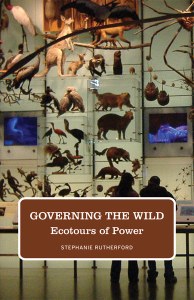
Take four emblematic American scenes: the Hall of Biodiversity at the American Museum of Natural History; Disney’s Animal Kingdom theme park; an ecotour of Yellowstone and Grand Teton National Parks; the film An Inconvenient Truth. Stephanie Rutherford shows how these sites are all manifestations of green governmentality, each seeking to define and regulate our understanding, experience, and treatment of nature.
From Disney amusement centers and natural history museums to Al Gore’s global warming spectaculars and American national parks, Stephanie Rutherford traces out the historical contingencies behind ‘green governmentality.’ Using this notion as her analytic of power, she develops an insightful analysis of how contemporary cultural politics and global markets help govern the wild and constitute the self in the U.S. through environmentally-driven consumer experiences.
Timothy W. Luke, Virginia Polytechnic Institute and State University
Take four emblematic American scenes: the Hall of Biodiversity at the American Museum of Natural History in New York; Disney’s Animal Kingdom theme park in Orlando; an ecotour of Yellowstone and Grand Teton National Parks; the film An Inconvenient Truth. Other than expressing a common interest in the environment, they seem quite dissimilar.
And yet, as Governing the Wild makes clear, these sites are all manifestations of green governmentality, each seeking to define and regulate our understanding, experience, and treatment of nature. Stephanie Rutherford shows how the museum presents a scientized assessment of global nature under threat; the Animal Kingdom demonstrates that a corporation can successfully organize a biopolitical project; the ecotour, operating as a school for a natural aesthetic sensibility, provides a visual grammar of pristine national nature; and the film offers a toehold on a moral way of encountering nature. But one very powerful force unites the disparate “truths” of nature produced through these sites, and that, Rutherford tells us, is their debt to nature’s commodification.
Rutherford’s analysis reveals how each site integrates nature, power, and profit to make the buying and selling of nature critical to our understanding and rescuing of it. The combination, she argues, renders other ways of encountering nature—particularly more radically environmental ways—unthinkable.
From Disney amusement centers and natural history museums to Al Gore’s global warming spectaculars and American national parks, Stephanie Rutherford traces out the historical contingencies behind ‘green governmentality.’ Using this notion as her analytic of power, she develops an insightful analysis of how contemporary cultural politics and global markets help govern the wild and constitute the self in the U.S. through environmentally-driven consumer experiences.
Timothy W. Luke, Virginia Polytechnic Institute and State University
Rutherford presents a clear and plausible account of green governmentality and the consumptive/redemptive story through her examination of these sites of cultural production and transmission.
Environmental Philosophy
Rutherford (Trent Univ.) offers a critical, thought-provoking analysis of communication about contemporary environmental problems.This book is eloquently written with an elaborate index. It will serve well as supplementary reading for graduate-level environmental studies, communication, and geography classes. A valuable resource for academic and public libraries. Summing Up: Highly recommended.
CHOICE
Readers with an interest in green governmentality and/or the commodification of nature will, though, find much to reflect on in Governing the Wild.
Social and Cultural Geography
Threading through strands of cultural and critical geography, the book Governing the Wild: Ecotours of Power offers a compelling treatise of how neoliberal political economy and culture have been deeply reinscribed in three popular North American tourist attractions and one film.
AAG Review of Books
Contents
Introduction: Governing Nature
1. Ordering Nature at the American Museum of Natural History
2. Disney’s Animal Kingdom: “The Wild Was Never This Wild”™
3. Wolves, Bison, and Bears, Oh My! Defining Nature at Yellowstone and Grand Teton National Parks
4. Science and Storytelling: Al Gore and the Climate Debate
Conclusion: Being Otherwise
Acknowledgments
Notes
Bibliography
Index
I am lucky to teach a course in environmental ethics to a lively, curious, and committed group of environmental studies students. Every year in the first class, I ask students what the words ‘nature’ and ‘wilderness’ mean to them. Responses usually follow the commonly held view, one now famously outlined and deconstructed by historian William Cronon in “The Trouble with Wilderness,” that nature is pristine, pure, untrammeled, and apart from humans. That the grooves of this story are so well worn shouldn’t come as a surprise; as Raymond Williams noted, nature is one of the most complicated words in the English language.