Ghostlife of Third Cinema
Asian American Film and Video
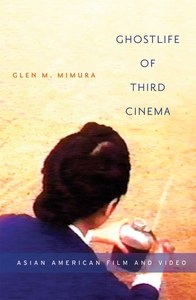
For Glen M. Mimura, Asian American cinema is the spectral return of the international film movement known as Third Cinema. Tracing contemporary Asian American cinema as a continuation of Third Cinema’s radical enterprise of making marginalized subjects visible in the First World, Ghostlife of Third Cinema examines such potent issues as diasporic identity, historical memory, and queer sexuality through sophisticated readings of a wide range of film and video projects.
Ghostlife of Third Cinema is a learned, beautifully written study, nothing less than a revisioning of U.S. history through the optic of Asian American visual representation.
Lisa Lowe, University of California, San Diego
Asian American filmmakers and video artists have created a substantial, diverse, and challenging body of work that reimagines the cultural and political representation of Asian Americans. Yet much of this work remains unknown.
For Glen M. Mimura, Asian American cinema is the spectral, ghostly return of the international film movement known as Third Cinema. Tracing contemporary Asian American cinema as a continuation of Third Cinema’s radical enterprise of making marginalized subjects visible in the First World, Ghostlife of Third Cinema examines such potent issues as diasporic identity, historical memory, and queer sexuality through sophisticated readings of a wide range of film and video projects, including Trinh T. Minh-ha’s experimental documentary Surname Viet Given Name Nam; avant-garde works by Japanese American filmmakers Rea Tajiri, Lise Yasui, and Janice Tanaka; and queer videos exploring the intersection of race, nation, and sexuality by Pablo Bautista, Ming-Yuen Ma, and Nguyen Tan Hoang.
In Ghostlife of Third Cinema, Mimura confronts the ongoing erasure of Asian American independent media and illuminates its cultural and political significance today.
Ghostlife of Third Cinema is a learned, beautifully written study, nothing less than a revisioning of U.S. history through the optic of Asian American visual representation.
Lisa Lowe, University of California, San Diego
I could not hold back my excitement while reading Ghostlife of Third Cinema—this is a project I have dreamed about for years. Glen Mimura’s seminal and sophisticated study calls for a major paradigm shift in Asian American and media studies.
Jun Xing, Oregon State University
A deeply felt, carefully considered work on Asian American cinema and video, Mimura’s delicate, concise study examines independent Asian American filmmaking with grace and authority. Numerous frame blowups add to the value of the work
Choice
Mimura’s discussion of both film and theory is rigorous, thoughtful, and inventive.
Afterimage
Mumura’s textual aalysis and comparison of the three filmmaker’s work [Pablo Bautista, Mint-Yuen S. Ma, Nguyen Tan Hoang] effectively describes some of the deceptive simplicity of each film’s execution while revealing its thematic complexity.
Afterimage
Ghostlife’s theoretical and artistic amplitude is impressive.
MELUS