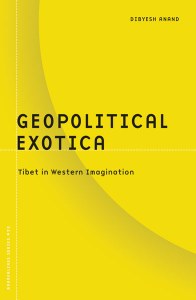
Geopolitical Exotica
Tibet in Western Imagination
Dibyesh Anand lays bare the strategies by which “Exotica Tibet” and “Tibetanness” have been constructed and investigates the impact these constructions have had on those who are being represented. In this masterfully synthetic work, Anand establishes that postcoloniality provides new insights into themes of representation and identity and demonstrates how IR as a discipline can meaningfully expand its focus beyond the West.
Dibyesh Anand’s Geopolitical Exotica is a significant contribution to postcolonial critiques that have forced western societies into a more considered and often painful acknowledgment of their imperial role in the creation of contemporary global problems.
Peter Bishop, author of The Myth of Shangri-La
Geopolitical Exotica examines exoticized Western representations of Tibet and Tibetans and the debate over that land’s status with regard to China. Concentrating on specific cultural images of the twentieth century-promulgated by novels, popular films, travelogues, and memoirs-Dibyesh Anand lays bare the strategies by which “Exotica Tibet” and “Tibetanness” have been constructed, and he investigates the impact these constructions have had on those who are being represented.
Geopolitical Exotica is the first book to explore representational practices within the study of international relations. Anand challenges the parochial practices of current mainstream international relations theory and practice, claiming that the discipline remains mostly Western in its orientation. His analysis of Tibet’s status with regard to China scrutinizes the vocabulary afforded by conventional international relations theory and considers issues that until now have been undertheorized in relation to Tibet.
In this masterfully synthetic work, Anand establishes that postcoloniality provides new insights into themes of representation and identity and demonstrates how IR as a discipline can meaningfully expand its focus beyond the West.
Dibyesh Anand’s Geopolitical Exotica is a significant contribution to postcolonial critiques that have forced western societies into a more considered and often painful acknowledgment of their imperial role in the creation of contemporary global problems.
Peter Bishop, author of The Myth of Shangri-La
Anand’s arguments are engaging, provocative and at times entertaining.
Times Literary Supplement
The attention Anand pays to representation, cultural production and imperial history, as well
as his use of theory, allow him to erode the boundaries of conventional IR. This transdisciplinarity is a sine qua non for an ethical approach to the non-western Other in IR.
Postcolonial Text
This is an original, elegant and striking treatment of a subject which has long needed some fresh ideas and clear thinking.
The China Journal