French Colonial Documentary
Mythologies of Humanitarianism
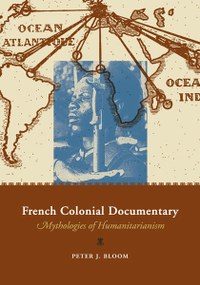
Tracing the visual rhetoric of French colonial humanitarianism, Peter J. Bloom’s unexpected analysis reveals how the project of remaking the colonies in the image of France was integral to its national identity. Bloom focuses on the promotion of French education efforts, hygienic reform, and new agricultural techniques in the colonies as a means of renegotiating the social contract between citizens and the state on an international scale.
French Colonial Documentary builds on the intertwined histories of colonial France and public health, with emphasis on the use of film in the context of preventive medicine. It contributes significantly to critical debates related to film and colonial history, modern France, and social geography.
Steven Ungar, University of Iowa
Despite altruistic goals, humanitarianism often propagates foreign, and sometimes unjust, power structures where it is employed. Tracing the visual rhetoric of French colonial humanitarianism, Peter J. Bloom’s unexpected analysis reveals how the project of remaking the colonies in the image of France was integral to its national identity.
French Colonial Documentary investigates how the promise of universal citizenship rights in France was projected onto the colonies as a form of evolutionary interventionism. Bloom focuses on the promotion of French education efforts, hygienic reform, and new agricultural techniques in the colonies as a means of renegotiating the social contract between citizens and the state on an international scale. Bloom’s insightful readings disclose the pervasiveness of colonial iconography, including the relationship between “natural man” and colonial subjectivity; representations of the Senegalese Sharpshooters as obedient, brave, and sexualized colonial subjects; and the appeal of exotic adventure narratives in the trans-Saharan film genre.
Examining the interconnection between French documentary realism and the colonial enterprise, Bloom demonstrates how the colonial archive is crucial to contemporary debates about multiculturalism in France.
Awards
Winner of the Wylie Prize in French Studies (2008-2009)
French Colonial Documentary builds on the intertwined histories of colonial France and public health, with emphasis on the use of film in the context of preventive medicine. It contributes significantly to critical debates related to film and colonial history, modern France, and social geography.
Steven Ungar, University of Iowa
Bloom’s scope and range are highly impressive, his close readings of the archives detailed and broadly persuasive. The volume’s archival foundations make it a useful source book for further study, particularly in view of its up-to-date annotated appendix of ‘Archives and Film and Media References.’ Overall, Bloom’s aim of extending the understanding of the imbrications of French colonial documentary and discourses of humanitarianism in the interwar period is successfully achieved in this richly detailed study.
L’Esprit Createur
Bloom’s bold yet nuanced readings of the cultural import of key events, films, and expositions, his careful contextualization of the forms he analyzes, and the sheer range of his sources provide a model for scholars hoping to interweave colonial and metropolitan cultural history. [An] immensely imaginative and well-researched study.
Arab Studies Journal
French Colonial Documentary underscores the importance of considering cinema and photography within an institutional, disciplinary, political and social context that reminds contemporary readers that the rhetoric of humanitarianism once served the West’s colonial ambitions, and this legacy remains today.
Substance
There is much to admire here, not least the breadth of Bloom’s analysis and his ability to unravel the various underpinnings of documentary film as discipline, art and colonial science.
Studies in Documentary Film