Francis Bacon
The Logic of Sensation
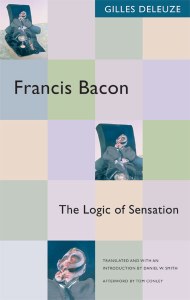
Translated with an introduction by Daniel W. Smith
Afterword by Tom Conley
This first English translation illuminates Francis Bacon’s paintings, the non-rational logic of sensation, and the act of painting itself, this work—presented in lucid and nuanced translation—also points beyond painting toward connections with other arts such as music, cinema, and literature. Francis Bacon is an indispensable entry point into the conceptual proliferation of Gilles Deleuze’s philosophy as a whole.
One of Deleuze’s most beautifully crafted studies, and an essential component of his aesthetic philosophy.
Southern Humanities Review
Translated and with an Introduction by Daniel W. Smith
Afterword by Tom Conley
Gilles Deleuze had several paintings by Francis Bacon hanging in his Paris apartment, and the painter’s method and style as well as his motifs of seriality, difference, and repetition influenced Deleuze’s work. This first English translation shows us one of the most original and important French philosophers of the twentieth century in intimate confrontation with one of that century’s most original and important painters. In considering Bacon, Deleuze offers implicit and explicit insights into the origins and development of his own philosophical and aesthetic ideas, ideas that represent a turning point in his intellectual trajectory.
First published in French in 1981, Francis Bacon has come to be recognized as one of Deleuze’s most significant texts in aesthetics. Anticipating his work on cinema, the baroque, and literary criticism, the book can be read not only as a study of Bacon’s paintings but also as a crucial text within Deleuze’s broader philosophy of art. In it, Deleuze creates a series of philosophical concepts, each of which relates to a particular aspect of Bacon’s paintings but at the same time finds a place in the “general logic of sensation.”
Illuminating Bacon’s paintings, the non-rational logic of sensation, and the act of painting itself, this work—presented in lucid and nuanced translation—also points beyond painting toward connections with other arts such as music, cinema, and literature. Francis Bacon is an indispensable entry point into the conceptual proliferation of Deleuze’s philosophy as a whole.
One of Deleuze’s most beautifully crafted studies, and an essential component of his aesthetic philosophy.
Southern Humanities Review
Deleuze’s developing style is well demonstrated by these essays, the translation of which maintains the philosopher’s exacting use of syntax and tone to connote non-rational ideas clearly. Art historians as well as scholars of 20th century intellectual history will find this a rich mine of original thought.
Library Journal
Long-awaited. This book is invaluable for an understanding of the trajectory of Deleuze’s own thought. Offers an entry point into Deleuze’s more explicitly theoretical work that simultaneously grounds and orients that theory in terms of a specific instance.
Journal of Aesthetics and Art Criticism
Gilles Deleuze’s Francis Bacon: The Logic of Sensation is in English at last. It is still as fresh as it was when it first appeared in 1981, but perhaps with new resonances and uses today.
John Rajchman, Bookforum
Deleuze’s study is fascinating. Deleuze’s book is really about sensation itself, or rather, a notion of sensation that is not a kind of procedural, Kantian container-sensation. For Deleuze, sensation is always a verb, not a noun, and this book is an attempt to make this movement and logic of sensation apparent—but not necessarily visible.
Leonardo