Database Aesthetics
Art in the Age of Information Overflow
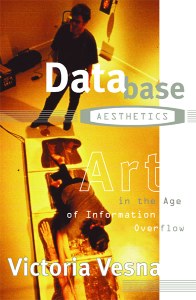
Database Aesthetics examines the database as cultural and aesthetic form, explaining how artists have participated in network culture by creating data art.
Contributors: Sharon Daniel, Steve Deitz, Lynn Hershman Leeson, George Legrady, Eduardo Kac, Norman Klein, John Klima, Lev Manovich, Robert F. Nideffer, Nancy Paterson, Christiane Paul, Marko Peljhan, Warren Sack, Bill Seaman, Grahame Weinbren.
This book ranges over a rich data bank of thoughts about and descriptions of digital media: from the software engines of video games to the conflicting interest of cinematic narratives, from the many skins of the stock market to the artificially intelligent spy, from the design of chip implants for the human body to the recombinant poetics of virtual worlds. Database Aesthetics claims the attention of anyone attuned to the design of current and incoming reality.
Michael Heim, author of Virtual Realism
Database Aesthetics examines the database as cultural and aesthetic form, explaining how artists have participated in network culture by creating data art. The essays in this collection look at how an aesthetic emerges when artists use the vast amounts of available information as their medium. Here, the ways information is ordered and organized become artistic choices, and artists have an essential role in influencing and critiquing the digitization of daily life.
Contributors: Sharon Daniel, U of California, Santa Cruz; Steve Deitz, Carleton College; Lynn Hershman Leeson, U of California, Davis; George Legrady, U of California, Santa Barbara; Eduardo Kac, School of the Art Institute of Chicago; Norman Klein, California Institute of the Arts; John Klima; Lev Manovich, U of California, San Diego; Robert F. Nideffer, U of California, Irvine; Nancy Paterson, Ontario College of Art and Design; Christiane Paul, School of Visual Arts in New York; Marko Peljhan, U of California, Santa Barbara; Warren Sack, U of California, Santa Cruz; Bill Seaman, Rhode Island School of Design; Grahame Weinbren, School of Visual Arts, New York.
This book ranges over a rich data bank of thoughts about and descriptions of digital media: from the software engines of video games to the conflicting interest of cinematic narratives, from the many skins of the stock market to the artificially intelligent spy, from the design of chip implants for the human body to the recombinant poetics of virtual worlds. Database Aesthetics claims the attention of anyone attuned to the design of current and incoming reality.
Michael Heim, author of Virtual Realism
Victoria Vesna’s edited anthology Database Aesthetics: Art in the Age of Information Overflow provides a compelling collection of 16 essays that engage the shifting aesthetics of computational and interactive art forms. Database Aesthetics supplies the reader with an absorbing and diverse cross-section of stylistic, analytical and theoretical examinations of the meaning of the database to interactive (and, in some cases, traditional) media. Furthermore, it showcases several practical instances of artworks configured using databases and provides the reader with valuable insights from the artists into the design, implementation and execution of these projects. It offers a number of intellectually robust, rewarding and thought-provoking approaches for those already immersed in digital culture and its critical discourses. This book serves as a timely and valuable resource for both the classroom and beyond.
Discourse
Related Publications

 Digital Art and Meaning
Reading Kinetic Poetry, Text Machines, Mapping Art, and Interactive Installations
Digital Art and Meaning
Reading Kinetic Poetry, Text Machines, Mapping Art, and Interactive Installations