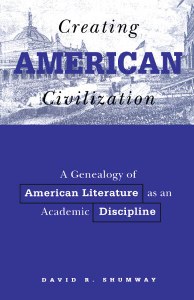
Creating American Civilization
A Genealogy of American Literature as an Academic Discipline
“‘American literature’ seems by now so natural and inevitable an entity that we forget that it did not just grow organically out of American soil, much less spring full blown from the minds of a few geniuses. In this highly readable study, David Shumway recovers the forgotten social, historical, and institutional conditions that explain why the concepts both of ‘literature’ and of distinctive literary Americanness emerged together at a particular time and place and how their merger reshaped America's educational vision. Shumway has written a penetrating and provocative account of the making of American Civilization as an academic field.” --Gerald Graff, University of Chicago
Shumway’s book puts forth a complex argument, clearly and entertainingly articulated.
Publishing Research Quarterly
“Shumway has written a penetrating and provocative account of the making of American civilization as an academic field.”
Gerald Graff
University of Chicago
David R. Shumway contends that American literature is the product of study - the deliberate invention of a discipline seeking to define the character and legitimate the existence of a specifically American civilization. He traces the various reconstitutions of American literature by examining the discipline’s practices and techniques, discourses and structures, paradigms and unstated assumptions.
This genealogy begins around 1890, when American literature as defined by institutions outside the academy, such as magazines and publishing houses, acquired much of the ideology it would display in later phases, including sexism, racism, and class bias. Singular in its treatment of American literary study as a discipline rather than as criticism and in its insistence on the cultural and political work carried on by this discipline, Creating American Civilization will engage literary theorists and historians as well as individuals with an interest in American literature.
Shumway’s book puts forth a complex argument, clearly and entertainingly articulated.
Publishing Research Quarterly
American Literature” seems by now so natural and inevitable an entity that we forget that it did not just grow organically out of American soil, much less spring full blown from the minds of a few geniuses. In this highly readable study, David Shumway recovers the forgotten social, historical, and institutional conditions that explain why the concepts both of “literature” and of distinctive literary Americanness emerged together at a particular time and place and how their merger reshaped America’s educational vision. Shumway has written a penetrating and provocative account of the making of American Civilization as an academic field.
Gerald Graff, University of Chicago
Shumway’s is a major synthetic history that will undoubtedly be central to future work on the subject. . . . . Shumway has made his book practical. . . . . For anyone interested in reinventing American literature, this is an essential history of what we have inherited.
American Literature
Shumway does a good job of presenting this complex picture. . . . . All in all, there’s good food for thought here, a usable past we might very well pay attention to as we ply our academic Pequod toward the future.
New England Quarterly
For readers outside the academy Creating American Civilization provides a fascinating glimpse of what goes on in the ivory tower. For those of us inside that tower the book is even more essential reading, yielding invaluable perspectives on what we do-and how , why, or whether we might choose to do it differently.
Rocky Mountain Review
“. . . excellent. . . . . Creating American Civilization not only deals in detail with a rich array of people and issues in literature and criticism but also offers keen speculation about broader themes of educational theory and practice, the rise of the university, the values that American culture embodies, and the significance of ‘nationalism’ as a political force.”The Journal of American History
Sweeping and informative.
College Literature