Corn Palaces and Butter Queens
A History of Crop Art and Dairy Sculpture
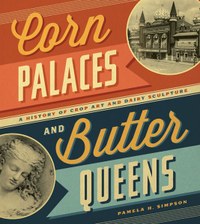
Between 1870 and 1930, from state fairs to the world’s fairs, large exhibition buildings were covered with grains, fruits, and vegetables to declare the United States’ rich agricultural abundance. From Teddy Roosevelt’s head sculpted from butter to the Liberty Bell replicated in oranges, Corn Palaces and Butter Queens is a history of one of America’s most beguiling Midwestern art forms.
Fortunate visitors to State Fairs in New York, Minnesota, Iowa and elsewhere never fail to make a pilgrimage to the butter sculptures: the cows, the dairy princesses, the famous athletes, and the rural scenes all rendered in pure, edible, spreadable gold. The spectators point, giggle, and marvel. Pamela H. Simpson does more in this dazzling study of foodstuff display, its history, and meaning. Butter effigies, ‘palaces’ covered in corn or potatoes, maidens made of wheat, and historic fortresses duplicated in apples speak to westward expansion, the birth of visual advertising, our American obsession with scale, and the culture of overabundance, as well as the pride and hopes of the farm. This is the very stuff of history in the making, a series of inventive recipes for national grandeur.
Karal Ann Marling, author of Designs on the Heart: The Homemade Art of Grandma Moses
Teddy Roosevelt’s head sculpted from butter. The Liberty Bell replicated in oranges. The Sioux City Corn Palace of 1891 encased with corn, grains, and grasses and stretching for two city blocks—with a trolley line running down its center. Between 1870 and 1930, from county and state fairs to the world’s fairs, large exhibition buildings were covered with grains, fruits, and vegetables to declare in no uncertain terms the rich agricultural abundance of the United States. At the same fairs—but on a more intimate level—ice-cooled cases enticed fairgoers to marvel at an array of butter sculpture models including cows, buildings, flowers, and politicians, all proclaiming the rich bounty and unending promise held by the region.
Often viewed as mere humorous novelties—fun and folksy, but not worthy of serious consideration—these lively forms of American art are described by Pamela H. Simpson in a fascinating and comprehensive history. From the pioneering cereal architecture of Henry Worrall at the Philadelphia Centennial Exposition to the vast corn palaces displayed in Sioux City, Iowa, and elsewhere between 1877 and 1891, Simpson brings to life these dazzling large-scale displays in turn-of-the-century American fairs and festivals. She guides readers through the fascinating forms of crop art and butter sculpture, as they grew from state and regional fairs to a significant place at the major international exhibitions. The Minnesota State Fair’s Princess Kay of the Milky Way contest, Lillian Colton’s famed pictorial seed art, and the work of Iowa’s “butter cow lady,” Norma “Duffy” Lyon, are modern versions of this tradition.
Beautifully illustrated with a bounty of never-before-seen archival images, Corn Palaces and Butter Queens is an accessible history of one of America’s most unique and beguiling Midwestern art forms—an amusing and peculiar phenomenon that profoundly affected the way Americans saw themselves and their country’s potential during times of drought and great depression.
Fortunate visitors to State Fairs in New York, Minnesota, Iowa and elsewhere never fail to make a pilgrimage to the butter sculptures: the cows, the dairy princesses, the famous athletes, and the rural scenes all rendered in pure, edible, spreadable gold. The spectators point, giggle, and marvel. Pamela H. Simpson does more in this dazzling study of foodstuff display, its history, and meaning. Butter effigies, ‘palaces’ covered in corn or potatoes, maidens made of wheat, and historic fortresses duplicated in apples speak to westward expansion, the birth of visual advertising, our American obsession with scale, and the culture of overabundance, as well as the pride and hopes of the farm. This is the very stuff of history in the making, a series of inventive recipes for national grandeur.
Karal Ann Marling, author of Designs on the Heart: The Homemade Art of Grandma Moses
Corn Palaces and Butter Queens will be THE book to fully document this sometimes odd but fascinating area of American cultural history, particularly important in the Midwest and Plains as the bread basket of the nation and world.
Colleen Sheehy, author of Seed Queen: The Story of Crop Art and the Amazing Lillian Colton
Comprehensive and impressively researched.
Book News, inc.
More than just an entertaining history of one of America’s art forms ... The book is richly illustrated with many never-before-seen images.
The News-Gazette
Pamela Simpson has revived an entire world of forgotten rural folk art, producing both a good read and a visual gem. Simpson’s work should be a staple at all county and state fairs this summer, and in museums detailing life in the United States from the 1880’s through the Great Depression.
BeyondChron
It’s a huge well-researched and beautifully produced coffee table book, lavishly illustrated with photos and commercial art about everything from seed art to buildings stuccoed with corn.
Dave Wood’s Book Report
If, like millions of others, you wondered how the Corn Palace got to be the Corn Palace, this is the book that will answer all your questions.
Palm Beach Post
A detailed but readable narrative that moves easily from a character study of a butter sculptor to a summary of the rise of the butter industry, from the iconography of a corn palace to the building’s role in a program of civic boosterism. Prompts the reader to pause and reconsider a deceptively simple art form. Food for thought, indeed.
Minnesota History
A finely researched book..., Corn Palaces and Butter Queens is a testament to a distinguished colleague. This is field that we are now able to enjoy through Pam’s creative and outstanding scholarship...
Buildings & Landscapes
Ultimately, Corn Palaces and Butter Queens is an engaging story of little known and overlooked art forms.
InVisible Culture
Contents
Preface
Acknowledgments
Introduction: Corn Palaces, Crop Art, and Butter Sculpture
1. Banquet Tables to Trophy Displays
2. Cereal Architecture
3. Butter Cows and Butter Ladies
4. America’s World’s Fairs, 1893-1915
5. Boosters, Saracens, and Indians
6. Mrs. Brooks and President Roosevelt
7. An Ongoing Tradition
Conclusion: Icons of Abundance
Notes
Publication History
Index