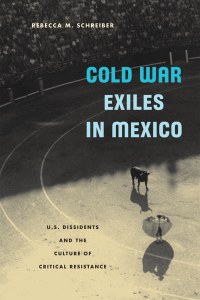
Cold War Exiles in Mexico
U.S. Dissidents and the Culture of Critical Resistance
Challenges notions of Cold War American art, culture, and politics
The onset of the Cold War in the 1940s and 1950s precipitated the exile of many U.S. writers, artists, and filmmakers to Mexico. Rebecca M. Schreiber illuminates the work of these cultural exiles and shows how the Cold War culture of political exile challenged American exceptionalist ideology and demonstrated the resilience of oppositional art, literature, and film in response to state repression.
"Highly original and innovative, Cold War Exiles In Mexico is an invaluable contribution to the scholarship on Cold War cultural production." —Penny Von Eschen, author of Satchmo Blows Up the World: Jazz Ambassadors Play the Cold War
The onset of the Cold War in the 1940s and 1950s precipitated the exile of many U.S. writers, artists, and filmmakers to Mexico. Rebecca M. Schreiber illuminates the work of these cultural exiles in Mexico City and Cuernavaca and reveals how their artistic collaborations formed a vital and effective culture of resistance.
As Schreiber recounts, the first exiles to arrive in Mexico after World War II were visual artists, many of them African-American, including Elizabeth Catlett, Charles White, and John Wilson. Individuals who were blacklisted from the Hollywood film industry, such as Dalton Trumbo and Hugo Butler, followed these artists, as did writers, including Willard Motley. Schreiber examines the artists’ work with the printmaking collective Taller de Gráfica Popular and the screenwriters’ collaborations with filmmakers such as Luis Buñuel, as well as the influence of the U.S. exiles on artistic and political movements.
The Cold War culture of political exile challenged American exceptionalist ideology and, as Schreiber reveals, demonstrated the resilience of oppositional art, literature, and film in response to state repression.
Highly original and innovative, Cold War Exiles In Mexico is an invaluable contribution to the scholarship on Cold War cultural production.
Penny Von Eschen, author of Satchmo Blows Up the World: Jazz Ambassadors Play the Cold War
Rebecca M. Schreiber's groundbreaking study interweaves archival historical research with insightful formal analyses of visual art, movies, and literature produced by U.S. Cold War exiles in Mexico during the 1940s and 1950s. Exploring the exiles’ relation to their host culture in all of its complexity, Schreiber illuminates the collaborative, inter-American dimensions of their innovative aesthetic projects.
Claire F. Fox, The University of Iowa
Schreiber highlights the interaction independent national cultures in the space of exile, and demonstrates how that syncretism continues to shape the cultural production of both nations. By doing this, she not only writes a chapter of repressed American history, she also offers a profound challenge to the concept of national, as well as intellectual, boundaries.
Mobilization
Schreiber’s study is an excellent contribution to the growing literature on transnational exchanges and should be required reading for Mexicanist and Americanist scholars of the Cold War.
The Americas
Her book should stand for a long time as the definitive analysis of the defiant cultural productions of Cold War exiles in Mexico.
Western American Literature
Schreiber’s book is informative and enlightening.
The American Historical Review
Any brief book review cannot adequately cover this pioneering study and I can only recommend readers to explore this work in depth.
Screening the Past
[Schreiber’s] book offers a series of fascinating analyses that illuminate works both famous and obscure and provide strong evidence for the fruitfulness of this kind of research. A model work of transnational cultural history, Cold War Exiles in Mexico helps to explain how the global Cold War spawned a global counterculture and generated widespread demands for civil and human rights and cultural autonomy.
Bulletin of Latin American Research
Cold War Exiles is characterized by attentive archival research and a largely well-written blend of literary and filmic history and analyses of Cold War cultural production.
Journal of American Studies
Schreiber’s close analysis of the films, writings, and artworks produced by American cultural figures in Mexico yields many interesting insights into the impact of exile on their treatment of such themes as race and dissent.
Hispanic American Historical Review
Schreiber has produced a thought-provoking, stimulating, and innovative account that sheds significant light on the potential of culture to either reinforce or contest predominant and official state narratives. Cold War Exiles is an important work and should be considered essential reading for scholars interested in cultural exchange, inter-American relations, and the politics of the early Cold War.
Journal of American Ethnic History
Related Publications
 The Art of Protest
Culture and Activism from the Civil Rights Movement to the Present, Second Edition
The Art of Protest
Culture and Activism from the Civil Rights Movement to the Present, Second Edition