Catching Hell in the City of Angels
Life and Meanings of Blackness in South Central Los Angeles
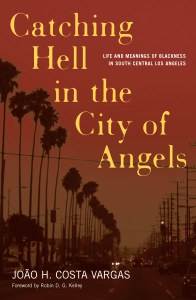
Joao Costa Vargas
A gripping account of South Central Los Angeles from the inside
Moving beyond stereotypes of South Central's predominantly African American residents, João H. Costa Vargas recounts his almost two years living in the district. Personal, critical, and disquieting, Catching Hell in the City of Angels examines the ways in which economic and social changes in the twentieth century have affected the black community and powerfully conveys the experiences that bind and divide its people.
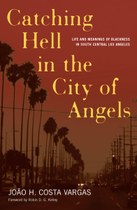
Since the 1980s, Los Angeles has become the most racially and economically divided city in the United States. Moving beyond stereotypes of South Central's predominantly African American residents, João H. Costa Vargas recounts his almost two years living in the district. Personal, critical, and disquieting, Catching Hell in the City of Angels examines the ways in which economic and social changes in the twentieth century have affected the black community and powerfully conveys the experiences that bind and divide its people.
Through compelling stories of South Central, including his own experience as an immigrant of color, Vargas presents portraits of four groups. He talks daily with women living in a low-income Watts apartment building; works with activists in a community organization against police brutality; interacts with former gang members trying to maintain a 1992 truce between the Bloods and the Crips; and listens to amateur jazz musicians who perform in a gentrified section of the neighborhood. In each case he describes the worldviews and the definitions of “blackness” these people use to cope with oppression. Vargas finds, in turn, that blackness is a form of racial solidarity, a vehicle for the renewal of African American culture, and a political expression of revolutionary black nationalism.
Vargas reveals that the social fault lines in South Central reflect both contemporary disparities and long-term struggles. In doing so, he shows both the racialized power that makes “blackness” a prized term of identity and the terrible price that African Americans have paid for this emphasis. Ultimately, Catching Hell in the City of Angels tells the story of urban America through the lives of individuals from diverse, overlapping, and vibrant communities.
$19.95 paper ISBN 978-0-8166-4169-7
$60.00 cloth ISBN 978-0-8166-4168-0
304 pages, 5 7/8 x 9, 2006
João H. Costa Vargas is assistant professor in the Center for African and African American Studies and the department of anthropology at the University of Texas, Austin.
Robin D. G. Kelley is the William B. Ransford Professor of Cultural and Historical Studies at Columbia University. He is the author of numerous books, including Yo Mama's Disfunktional: Fighting the Culture Wars in Urban America.
contents
Foreword robin d. g. kelley
Introduction: Looking Forward to Looking Forward
1. Blackness as Exclusion and Isolation: The Making of Inequalities in South Central
2. Blackness as Sorrow and Solidarity: Women and the Ethics of Caring
3. Blackness as Liability and Powerlessness: Community under Siege and the Welfare State
4. Blackness as Mobilization and Movement: The Coalition Against Police Abuse and the Panther Legacy
5. Blackness as Artistry and Affirmation: Leimert Park and the Idioms of Jazz
6. Blackness as Self-Help and Social Critique: The Community in Support of the Gang Truce
Conclusion: Blackness as Blueprint for Social Transformation
Acknowledgments
Appendix: CAPA’s Community Organizing Manual
Notes
Index

About This Book
Related Publications
Stirrings in the Jug
Black Politics in the Post-Segregation Era
A penetrating look at the state of racial politics by one of our nation’s most important writers on the subject.
Gang Nation
Delinquent Citizens in Puerto Rican, Chicano, and Chicana Narratives
Explores how Latino gang culture mirrors the most destructive aspects of the American Dream through a look at novels and memoirs
Revolutionaries to Race Leaders
Black Power and the Making of African American Politics
What happened to the revolutionary goals of the Black Power movement?
Jim Crow Nostalgia
Reconstructing Race in Bronzeville
An incisive analysis of racial identity in urban politics
A World of Gangs
Armed Young Men and Gangsta Culture
From L.A. to Lagos, Port-au-Prince to Paris—a provocative analysis of the global proliferation of street gangs
Policing Space
Territoriality and the Los Angeles Police Department
Policing Space is a fascinating firsthand account of how the Los Angeles Police Department attempts to control its vast, heterogeneous territory. As such, the book offers a rare, ground-level look at the relationship between the control of space and the exercise of power.
Constructions of Race, Place, and Nation
A riot in Los Angeles, a skinhead rally in Fulda, burnings in Johannesburg, massacres in Sarajevo: with racism on the rise and nationalism fracturing societies, the juncture of race, place, and nation has become a crucial one. This volume explores this critical intersection, offering a much-needed new perspective on a world in crisis.
Contributors: Kay J. Anderson, Alastair Bonnett, Heléne Clark, Claire Dwyer, Jane M. Jacobs, Susan J. Smith, and the editors.
The Bubbling Cauldron
Race, Ethnicity, and the Urban Crisis
How can race and ethnicity be understood as questions of power? How do changes among racial and ethnic groups alter conflicts about these groups’ identities and the resultant power structure shaped by these conflicts? The contributors to this important new volume take up these questions and others as they delve beneath the turbulent surface of racial and ethnic relations in urban centers worldwide.
Contributors: Sophie Body-Gendrot, the Sorbonne and the Institute of Political Science, Paris; Harold Brackman, Simon Wiesenthal Center; James Button, U of Florida; Sharon Collins, U of Illinois, Chicago; Steven P. Erie, U of California, San Diego; Norman Fainstein, Vassar College; Cedric Herring, U of Illinois, Chicago; Michael Hodge, Georgia State U; Leslie Baham Inniss, Florida State U; Martín Sánchez Jankowski, U of California, Berkeley; Michael Kearney, U of California, Riverside; Edward Murguia, Texas A&M; Adolph Reed Jr., Northwestern U; Nestor Rodríguez, U of Houston; Bernadette Tarallo, U of California, Davis; Roger Waldinger, UCLA; and Howard Winant, Temple U.
Race in the Hood
Conflict and Violence among Urban Youth
A compelling study of the origins of racial conflict and violence in America.
The Neoliberal Deluge
Hurricane Katrina, Late Capitalism, and the Remaking of New Orleans
A critical collection on the politics of disaster and reconstruction in New Orleans
Saigon’s Edge
On the Margins of Ho Chi Minh City
Exploring the places where the rural and urban intersect, where many of the world’s people live