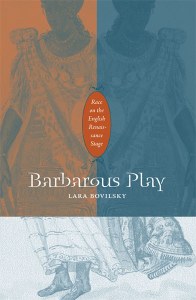
Barbarous Play
Race on the English Renaissance Stage
Barbarous Play examines English Renaissance understandings of race as depicted in drama. Reading plays by Shakespeare, Marlowe, Webster, and Middleton, Lara Bovilsky offers case studies of how racial meanings are generated by narratives of boundary crossing—especially miscegenation, religious conversion, and class transgression. In the process, she argues that understanding just what is false and figurative in past depictions of race can clarify the illogic of present-day racism.
An excellent and complex study of the racial logics that shaped the literature and culture of the Renaissance, Barbarous Play belongs to the next generation of scholarship on the history of race studies by actually taking measure of ‘how far we have come, and where we are going.’
Jyotsna G. Singh, Michigan State University
Like our own, early modern beliefs about race depended on metaphorical, selective, and contradictory understandings of how membership in groups is determined. Although race took distinctive forms in the past, the fallacies that underlie early modern racial experience generally are precisely—and surprisingly—the same as those in contemporary culture.
Exploring the similar underpinnings of early modern and contemporary ideas of difference, Barbarous Play examines English Renaissance understandings of race as depicted in drama. Reading plays by Shakespeare, Marlowe, Webster, and Middleton, Bovilsky offers case studies of how racial meanings are generated by narratives of boundary crossing—especially miscegenation, religious conversion, class transgression, and moral and physical degeneracy. In the process, she reveals deep parallels between the period’s conceptions of race and gender.
Barbarous Play contests the widely held view that race and racism depend on modern science for their existence and argues that understanding just what is false and figurative in past depictions of race, such as those found in Othello, The Merchant of Venice, The White Devil, and The Changeling, can clarify the illogic of present-day racism.
An excellent and complex study of the racial logics that shaped the literature and culture of the Renaissance, Barbarous Play belongs to the next generation of scholarship on the history of race studies by actually taking measure of ‘how far we have come, and where we are going.’
Jyotsna G. Singh, Michigan State University
An extraordinarily rich and impressive book.
Platforms
Barbarous Play is a rich and provocative work. I suspect and hope Bovilsky’s text will be pivotal in the field of race on the early modern stage.
Renaissance Quarterly
This is a very timely book. One of the strengths of [Barbarous Play] is the range of research that has been carried out, and the critical analysis is of the highest order. It offers much in its detailed case studies and close investigations, and is certainly worth consideration.
M/C Reviews
Barbarous Play is a valuable contribution to our understanding of racial discourse, in the present as well as the past.
Journal of British Studies
Insightful, nuanced and a persuasive contribution to ongoing debates about race. Bovilsky’s book is impressive in its clarity and focus. Each chapter is succinctly and cogently argued as well as engaging.
Shakespeare Bulletin