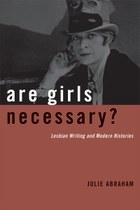
Are Girls Necessary?
Lesbian Writing and Modern Histories
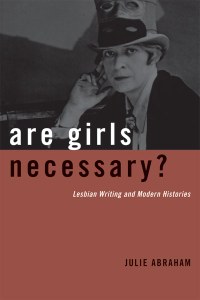
In this analysis of twentieth-century lesbian writing, Julie Abraham offers new readings of pulp novelists alongside high modernists—authors as various as Gertrude Stein, Willa Cather, Mary Renault, and Virginia Woolf—to examine how these writers created new lesbian narratives.
Anyone with a poignant interest in lesbian writing—its history and ramifications in the literary world—will welcome the challenge presented in Abraham's studies.
Lambda Book Report
Anyone with a poignant interest in lesbian writing—its history and ramifications in the literary world—will welcome the challenge presented in Abraham's studies.
Lambda Book Report
Valuable both for the perspicacity of the brilliant nuggets that turn up in Abraham’s excavation of her subject and for the clear, liberating distinction she makes between ‘lesbian novels’ and ‘lesbian writing.’
Harvard Gay and Lesbian Review
Contributes significantly to our understandings not only of the particular writers discussed but of literary modernism and lesbian writing more generally. Abraham’s book breaks new ground in its teasing out of the meanings and functions of ‘history’ in lesbian writing. It’s a must-read for scholars in the field—and not just because it has such a great title.
Lesbian Review of Books
The discussions of individual writers in Are Girls Necessary? are uniformly astute and provocative in company with one another.
Women’s Review of Books
Abraham’s book enters an ongoing debate about what constitutes a lesbian text or lesbian writing and offers a fascinating solution, with important insights into the uses of history by modernist lesbian writers. These insights warrant close attention.
Modern Language Quarterly
Carefully argued, intelligently written.
Modern Language Review
Forceful and original. An important contribution to lesbian studies.
Modern Fiction Studies
Readers and critics interested in English literature, gender studies, gay/lesbian studies, and literary criticism alike will want to revisit the writers discussed in light of Abraham’s cogent, provocative analysis.
Choice
Are Girls Necessary? has been, and continues to be, an important reference for anyone studying lesbian writing.
Feminist Formations
Contents
Preface: "Are Girls Necessary?"
Introduction: "I Have a Narrative”
Part I: "Tell the Lacadaemonians"
1. Willa Gather's New World Histories
2. Mary Renault's Greek Drama
Part II: "Love Is Writing"
3. Washington, James, (Toklas), and Stein
4. Djuna Barnes, Memory, and Forgetting
5. Virginia Woolf and the Sexual Histories of Literature
Afterword: "Reading and the Experiences of Everyday Life"
Notes
Index