Animal Stories
Narrating across Species Lines
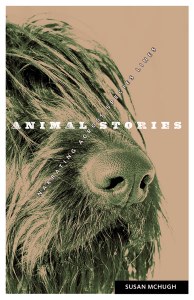
Animal Stories argues that key creative developments in narrative form became inseparable from shifts in animal politics and science in the past century. Susan McHugh traces representational patterns specific to modern and contemporary fictions of cross-species companionship through a variety of media to show how nothing less than the futures of all species life is at stake in narrative forms.
Susan McHugh offers a cultural history of human-animal relationships in the twentieth and twenty-first centuries as traced in imaginative as well as scientific and political work. McHugh challenges us to rethink how we conceptualize the creatures involved. Animal Stories thus tells us as much about animals as it does about the role of the human imagination and as such will be necessary reading for all those interested in reading literature with other media and in thinking ethically about our place in the natural world.
Erica Fudge, author of Animal
Beginning with a historical account of why animal stories pose endemic critical challenges to literary and cultural theory, Animal Stories argues that key creative developments in narrative form became inseparable from shifts in animal politics and science in the past century. Susan McHugh traces representational patterns specific to modern and contemporary fictions of cross-species companionship through a variety of media—including novels, films, fine art, television shows, and digital games—to show how nothing less than the futures of all species life is at stake in narrative forms.
McHugh’s investigations into fictions of people relying on animals in civic and professional life—most obviously those of service animal users and female professional horse riders—showcase distinctly modern and human–animal forms of intersubjectivity. But increasingly graphic violence directed at these figures indicates their ambivalent significance to changing configurations of species.
Reading these developments with narrative adaptations of traditional companion species relations during this period—queer pet memoirs and farm animal fictions—McHugh clarifies the intercorporeal intimacies—the perforations of species boundaries now proliferating in genetic and genomic science—and embeds the representation of animals within biopolitical frameworks.
Awards
Winner of the 2012 Society for Literature, Science, and the Arts Michelle Kendrick Memorial Book Prize
Susan McHugh offers a cultural history of human-animal relationships in the twentieth and twenty-first centuries as traced in imaginative as well as scientific and political work. McHugh challenges us to rethink how we conceptualize the creatures involved. Animal Stories thus tells us as much about animals as it does about the role of the human imagination and as such will be necessary reading for all those interested in reading literature with other media and in thinking ethically about our place in the natural world.
Erica Fudge, author of Animal
An important contribution to the study of the posthumanities.
CHOICE
McHugh’s ambitious effort to establish the sustained importance of animal life in the margins of literary studies, the artistic arena in which animals have perhaps been most rigorously and consistently jettisoned to the status of metaphor, is to be commended. Her success in this project is largely due to her keen attention to the visual registers of narrative, and future scholarship in the field will doubtless be enriched by her innovative focus.
Reviews in Cultural Theory
For readers interested in truly original insights into twentieth-century animal narratives and their intersections with lives shared across species.
Humanimalia
Each chapter constitutes a unique interspecies history lesson.
The Goose
McHugh’s ambitious effort to establish the sustained importance of animal life in the margins of literary studies, the artistic arena in which animals have perhaps been most rigorously and consistently jettisoned to the status of metaphor, is to be commended. Her success in this project is largely due to her keen attention to the visual registers of narrative, and future scholarship in the field will doubtless be enriched by her innovative focus.
Reviews in Cultural Theory
By using narrative forms to navigate between the paradigms of literary studies and ethology, McHugh offers new insights into the complexity of what it means to live with other species and to write with them in mind.
Organization and Environment
As McHugh’s study of animal stories shows, in the twentieth century and the last ten years, literary and visual artists have registered the need to innovate the forms of representation and extend the franchise beyond the human—or, as she might say, with the nonhuman. In a time characterized by growing awareness of the ravages of climate change, unprecedented loss of biodiversity, and the host of political, social, and economic problems engendered by exponential human population growth, these innovative forms make undeniable claims on us and deserve the utmost consideration.
Configurations
Animal Stories is a utopian account of the possibilities of feminist, queer, non-ableist, multispecies collectivities against the ever-present threat of atomization and retrenchment.
American Literature
Acknowledgments
Introduction: Animal Narratives and Social Agency
Part I. Intersubjective Fictions
1. Seeing Eyes/Private Eyes: Service Dogs and Detective Fictions
2. Velvet Revolutions: Professions of Girl-Horse Stories
Part II. Intercorporeal Narratives
3. Breeding Narratives of Intimacies: Shaggy Dog to Shagging Sheep Stories
4. Farm Animal Fictions and Futures: Semi-Living to GMO Pig Tales
Conclusion: Toward a Narrative Ethology
Notes
Index