Alien Phenomenology, or What It’s Like to Be a Thing
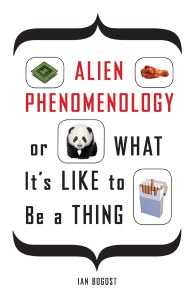
In this book, Ian Bogost develops an object-oriented ontology that puts things at the center of being—a philosophy in which humans are elements but not the sole or even primary elements of philosophical interest. Bogost encourages professional thinkers to become makers as well, engineers who construct things as much as they think and write about them.
This book needs to be read by many different audiences since it is not only fascinating but also of considerable significance. As the task of thinking through things as actors in their own right according to Ian Bogost’s maxim ‘all things exist, yet they do not exist equally’ becomes a real intellectual project so the implications of this stance start to multiply. In turn, they begin to produce the outlines of a landscape in which things aren’t just are. Rather, they form an active cartography which is always and everywhere—an alien ontography.
Nigel Thrift, Vice Chancellor, University of Warwick
Humanity has sat at the center of philosophical thinking for too long. The recent advent of environmental philosophy and posthuman studies has widened our scope of inquiry to include ecosystems, animals, and artificial intelligence. Yet the vast majority of the stuff in our universe, and even in our lives, remains beyond serious philosophical concern.
In Alien Phenomenology, or What It’s Like to Be a Thing, Ian Bogost develops an object-oriented ontology that puts things at the center of being—a philosophy in which nothing exists any more or less than anything else, in which humans are elements but not the sole or even primary elements of philosophical interest. And unlike experimental phenomenology or the philosophy of technology, Bogost’s alien phenomenology takes for granted that all beings interact with and perceive one another. This experience, however, withdraws from human comprehension and becomes accessible only through a speculative philosophy based on metaphor.
Providing a new approach for understanding the experience of things as things, Bogost also calls on philosophers to rethink their craft. Drawing on his own background as a videogame designer, Bogost encourages professional thinkers to become makers as well, engineers who construct things as much as they think and write about them.
This book needs to be read by many different audiences since it is not only fascinating but also of considerable significance. As the task of thinking through things as actors in their own right according to Ian Bogost’s maxim ‘all things exist, yet they do not exist equally’ becomes a real intellectual project so the implications of this stance start to multiply. In turn, they begin to produce the outlines of a landscape in which things aren’t just are. Rather, they form an active cartography which is always and everywhere—an alien ontography.
Nigel Thrift, Vice Chancellor, University of Warwick
The colored plates are wonderful, as is the general look and feel of the book.
Environmental Critique
Engaging, unpretentious, and often beautiful.
PopMatters.com
Alien Phenomenology is worth a read simply because it is innovative, cleverly written, and bold.
Indie Street Radio
Bogost goes a step further to describe not just what [object-oriented ontology] is, but how one would go about practicing it.
Experimental Progress, blog
The possibilities of Bogost’s theory applied to fine arts, theater, music, education, and even science are endless.
New Orleans Review
Bogost’s book effectively constitutes an exhortation to humans to “stop and smell the aliens”—to allow the experience of attempting to think outside of a human conceptual framework to facilitate new ways of thinking that are based in speculation and analogy.
Invisible Culture
The power of Alien Phenomenology, in my reading, is a recreation of a sense of wonder about
everything we are in contact with, including the things we craft.
Itineration Journal
It is a list, a catalogue, a community of things. It is also a kind of travelogue, a “Latour litany” that maps some of the objects populating Ian Bogost’s beautifully written and wonderfully stimulating new book, Alien Phenomenology, or What It’s Like to Be a Thing. Though it will be of special interest to readers with an interest in literature, philosophy, and the humanities, the book itself speaks beyond any single disciplinary frame.
Carla Nappi, Anthem Magazine
Beautifully written and wonderfully stimulating.
Anthem
The refreshing voice of Bogost’s philosophy is well-suited to the brand of ontology he champions, and the strength of his prose is its capacity to communicate complex concepts in a straightforward fashion without oversimplifying or essentializing.
SubStance
Contents
1. Alien Phenomenology
2. Ontography
3. Metaphorism
4. Carpentry
5. Wonder
Acknowledgments
Notes
Bibliography
Index