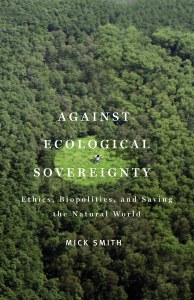
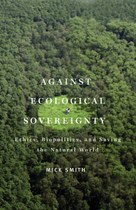
Against Ecological Sovereignty
Ethics, Biopolitics, and Saving the Natural World
Links the political critique of sovereign power with ecological concerns
Against Ecological Sovereignty is a passionate defense of radical ecology that speaks directly to current debates concerning the nature, and dangers, of sovereign power. Mick Smith reconnects the political critique of sovereign power with ecological considerations, arguing that ethical and political responsibilities for the consequences of our actions do not end with those defined as human.
"Very occasionally one comes across a book that is genuinely original. Mick Smith's interrogation of ecological sovereignty offers an entirely new perspective on the dangers and opportunities involved in defining our current condition as an ecological ‘crisis.’ As a reassertion of the need for a politics and ethics of the environment, Smith's argument is fresh, very intelligent, and hard to beat."—Andrew Dobson, author of Citizenship and the Environment
Against Ecological Sovereignty is a passionate defense of radical ecology that speaks directly to current debates concerning the nature, and dangers, of sovereign power. Engaging the work of Bataille, Arendt, Levinas, Nancy, and Agamben, among others, Mick Smith reconnects the political critique of sovereign power with ecological considerations, arguing that ethical and political responsibilities for the consequences of our actions do not end with those defined as human.
Against Ecological Sovereignty is the first book to turn Agamben’s analysis of sovereignty and biopolitics toward an investigation of ecological concerns. In doing so it exposes limits to that thought, maintaining that the increasingly widespread biopolitical management of human populations has an unrecognized ecological analogue—reducing nature to a “resource” for human projects. Smith contends that a radical ecological politics must resist both the depoliticizing exercise of sovereign power and the pervasive spread of biopolitics in order to reveal new possibilities for creating healthy human and nonhuman communities.
Presenting a stinging critique of human claims to sovereignty over the natural world, Smith proposes an alternative way to conceive of posthumanist ecological communities—one that recognizes the utter singularity of the beings in them.
Very occasionally one comes across a book that is genuinely original. Mick Smith's interrogation of ecological sovereignty offers an entirely new perspective on the dangers and opportunities involved in defining our current condition as an ecological ‘crisis.’ As a reassertion of the need for a politics and ethics of the environment, Smith's argument is fresh, very intelligent, and hard to beat.
Andrew Dobson, author of Citizenship and the Environment
Smith’s book is a valuable contribution to philosophical literature.
Choice
The most systematic work of explicitly ecological anarchism since Alan Carter’s book A Radical Green Political Theory (1999), and it deserves a suitable audience as such.
Environmental Values
The book interacts extensively with the history of ethics and its contemporary ecological implications in productive ways.
Radical Philosophy
A valuable text for disciplines concerned with human ecology and posthumanist perspectives including geography, philosophy, sociology, anthropology and environmental studies.
The Australian Journal of Anthropology
Contents
Acknowledgments
Introduction: A Grain of Sand
1. Awakening
2. The Sovereignty of Good
3. Primitivism: Anarchy, Politics, and the State of Nature
4. Suspended Animation: Radical Ecology, Sovereign Powers, and Saving the (Natural) World
5. Risks, Responsibilities, and Side Effects: Arendt, Beck, and the Politics of Acting into Nature
6. Articulating Ecological Ethics and Politics
7. Against Ecological Sovereignty
Apologue: In Relation to the Lack of Environmental Policy
Notes
Bibliography
Index