A Manufactured Wilderness
Summer Camps and the Shaping of American Youth, 1890–1960
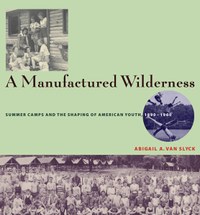
Abigail A. Van Slyck trains an informed eye on the most visible and evocative aspect of summer camp life: its landscape and architecture. Far from a simple encounter with nature, Van Slyck argues that camps provided a man-made version of wilderness, shaped by middle-class anxieties about gender roles, class tensions, race relations, and modernity and its impact on children.
Van Slyck breaks important new ground in examining the landscape of summer camps. In her imaginative and rigorous analysis, she reveals much about the nature of place and proves that summer camps are an excellent, if long overlooked, setting for such inquiry, for they reveal how the experiences of youth can have a lasting impact on our lives.
Richard Longstreth, George Washington University
Since they were first established in the 1880s, children’s summer camps have touched the lives of millions of people. Although the camping experience has a special place in the popular imagination, few scholars have given serious thought to this peculiarly American phenomenon. Why were summer camps created? What concerns and ideals motivated their founders? Whom did they serve? How did they change over time? What factors influenced their design?
To answer these and many other questions, Abigail A. Van Slyck trains an informed eye on the most visible and evocative aspect of camp life: its landscape and architecture. She argues that summer camps delivered much more than a simple encounter with the natural world. Instead, she suggests, camps provided a man-made version of wilderness, shaped by middle-class anxieties about gender roles, class tensions, race relations, and modernity and its impact on the lives of children.
Following a fascinating history of summer camps and a wide-ranging overview of the factors that led to their creation, Van Slyck examines the intersections of the natural landscape with human-built forms and social activities. In particular, she addresses changing attitudes toward such subjects as children’s health, sanitation, play, relationships between the sexes, Native American culture, and evolving ideas about childhood.
Generously illustrated with period photographs, maps, plans, and promotional images of camps throughout North America, A Manufactured Wilderness is the first book to offer a thorough consideration of the summer camp environment.
Architecture, Landscape, and American Culture Series
Awards
New England American Studies Association — Lois P. Rudnick Book Prize — Manufactured Wilderness honorable mention 2006
Vernacular Architecture Forum — Abbott Lowell Cummings Award — A Manufactured Wilderness 2008
Society of Architectural Historians — Alice Davis Hitchcock Book — A Manufactured Wilderness 2009
Van Slyck breaks important new ground in examining the landscape of summer camps. In her imaginative and rigorous analysis, she reveals much about the nature of place and proves that summer camps are an excellent, if long overlooked, setting for such inquiry, for they reveal how the experiences of youth can have a lasting impact on our lives.
Richard Longstreth, George Washington University
A Manufactured Wilderness is a wonderful book on an important topic. Summer camps provide a fascinating window into the workings of gender, and Abigail A. Van Slyck does a fine job of tracing this history of socialization and education through camp life.
Dolores Hayden, author of Building Suburbia: Green Fields and Urban Growth, 1820-2000
Drawing on archival data, especially old photos, maps, and structural design plans, Van Slyck provides a sociohistorical review of this particular culture.
Tim Delaney, SUNY at Oswego
This book takes up the American adult impulse to give its children—and future adults—a better life than the adults enjoy by returning the youths to the former ‘youthful,’ ‘primitive’ and pre-industrial civilization. Van Slyck’s recounting of the movement is successful. This fine study takes a part of the development of modern society if not from the cradles to the grave then at least from childhood to adulthood. Architectural and cultural historians will find this book useful. Van Slyck’s interpretation of the manufactured environment through archival images is excellent. This thoughtful study demonstrates the changing definitions and needs of childhood, but, equally important, it shows how concepts of race, class, and gender were transferred to children through a seemingly innocent wilderness vacation.
Journal of American Culture
Since their first appearance in the 1880s, summer camps—and the experiences they offered—have shaped the lives of millions of Americans over the years. Here Van Slyck provides a history of camping with a touch of sociological flavor, bringing in such issues as social class, race, and gender. In so doing she offers readers a complete picture of summer camps, their appeal, the variety of children who attended summer camps, and how children were served by the summer camp experience. Her approach is architectural, as the main title suggests: she looks at how these created wildernesses reflected life and values in the U.S. She also provides fascinating period photos. Although it classes under recreation and leisure, this book is best suited to those in the social and behavioral sciences. Summing up: Recommended. All readers; all levels.
Choice
A Manufactured Wilderness is an interesting historical review for camp directors and camp alumni seeking to understand how and why their camp property and buildings were developed. It illustrates the continuing influence of century-old social trends on current camp programming.
International Journal of Wilderness
The book is generously illustrated with period photographs, maps, plans and promotional images of camps throughout North America.
Crossroads Chronicle
Van Slyck examines the intersections of the natural landscape with human-built forms and social activities. She addresses changing attitudes toward children’s health, sanitation, play, relationships between the sexes, Native American culture and evolving ideas about childhood.
Lake Country Echo
A Manufactured Wilderness by Abigail A. Van Slyck provides an interesting look at why summer camps of the Frank A. Day era were created, how they were influenced by the social and cultural trends of their time, and how they influenced the development of generations of youth.
Telegram & Gazette
Van Slyck's work is an informative and comprehensive look at its subject.
Library Journal
Sure to be of interest to readers who want to learn more about the physical and cultural landscape of the summer camps they attended as children or are sending their own children to now.
Chicago Tribune
A Manufactured Wilderness is an original work done in masterful fashion. Van Slyck vividly and convincingly highlights the connections between landscape, design, and culture. Every step of the way, she notes how the layouts of the camps and the activities children took part in were fraught with cultural meaning. No detail of camp life escapes her watchful eye.
Journal of Popular Culture
A lavishly illustrated and imaginatively sourced book. Van Slyck’s research base is just as impressive as the interdisciplinary character of her analysis. A Manufactured Wilderness is a fine example of interdisciplinary history and an imaginative investigation of a subject that deserves more attention from historians.
Journal of Interdisciplinary Studies
I am in awe of how Van Slyck makes use of not only photographs, but of landscape and architectural plans as well, to construct an argument for the importance of the built environment. To read A Manufactured Wilderness and study its images is to walk through a landscape in which cabins, fire rings, and even latrines are invested with profound cultural meaning.
Winterthur Portfolio
Van Slyck’s analytical framework lends itself well to an evaluation of summer camps in the present day. Van Slyck offers a history that may make a reader nostalgic for the days when summer camps were intended to build healthy bodies and ‘character’ rather than college application portfolios.
Journal of Social History
Van Slyck’s astute analysis is carefully researched and elegantly written—even when the subject is as mundane as the personal hygiene of campers. A Manufactured Wilderness will appeal to an array of readers . . . In addition, anyone who has ever attended summer camp will be fascinated to read Van Slyck’s serious examination of children’s play and adults’s manipulation of it. A Manufactured Wilderness is an excellent resource for understanding the material culture of summer camps, a subject that deserves the serious attention Van Slyck provides.
AARIS
Abigail A. Van Slyck . . . has written a richly textured history of the American summer camp that deepens our understanding of how the designs we take for granted are often laden with unexpected meaning. This critical study, which brings together a rich variety of evidence, is a welcome contribution to the history of American culture, the history of architecture and design, and the history of childhood.
Design and Culture
Well-researched and insightful.
Journal of Architecture
A Manufactured Wilderness is an interesting and historic review of early American camps during a time of great social and cultural transformation. It is an approachable read with a wealth of photographs, drawings and paintings that would be of interest to camp directors alumni and staff—particularly those affiliated with the camps examined in the book. Cultural historians and university faculty with teaching and research interests in architectural and landscape architectural history should find Van Slyck’s investigation of a relatively uncultivated area of study compelling.
Children, Youth, Environments Journal
Van Slyck offers a good introduction to the thinking behind the built environment and the way it shapes and frames our experience of nature. Her work raises awareness of site development and shaping, of space and usage, applicable to other areas of study.
Western Folklore
Van Slyck produces a rich and accessible text that draws from a myriad of photographs, illustrations, and maps. She thoroughly reconstructs the architectural history of organized camps to investigate the spatial relationship between function and culture. Her vivid descriptions, illustrations, and images affectively reimagine the camp landscape while demonstrating how the fabricated environment reinforces certain ideas, values and behaviors within campers. Van Slyck produces a lucid narrative of historical understanding of the relationship between children and nature.
Historical Geography