Private Screenings
Television and the Female Consumer
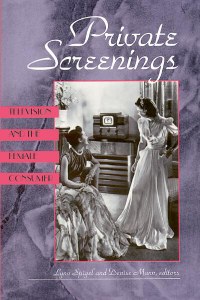
Analyzes how television delivers definitions of “femininity” to its female audiences. Includes a source guide for television shows from 1946-1970.
Contributors: Julie D’Acci, Sarah Berry, Aniko Bodroghkozy, Robert H. Deming, Dan Einstein, Sandy Flitterman-Lewis, Mary Beth Haralovich, Lynne Joyrich, William Lafferty, Nina Liebman, George Lipsitz, Denise Mann, Lynn Spigel, Jillian Steinberger and Randall Vogt.
This material is highly appropriate for teaching. Valuable for courses in women’s studies, social history, and media historiography. The essays represent the type of socio-cultural research into popular entertainment history which has only recently emerged in media studies and which constitutes one of the most fertile fields of scholarship at the moment.
Lauren Rabinovitz, University of Iowa

In an incisive look at the relationship between women, television, and consumer culture from the 1950s to the present, Private Screenings focuses on the complex interplay of television and the female consumer/audience. From the introduction of television to American domestic space, Private Screenings examines how television has historically treated race, class, and gender. While much of the research in this field has been historical, textual, or empirical, this volume approaches the topic from a sociocultural and feminist perspective to address important questions from the viewpoint of the audience as well as that of the industry.
Drawing from a wide variety of genres, including situation comedies, police shows, variety shows, and ethnic family dramas, the authors in this collection explore the ways in which the television industry has inserted itself into women’s lives, both at home and in the marketplace. The essays examine the concept of this “private screening” in which “consumption” is sold to female viewers as a necessary element of a rich, fulfilled life.
Contributors: Julie D'Acci, Sarah Berry, Aniko Bodroghkozy, Robert H. Deming, Dan Einstein, Sandy Flitterman-Lewis, Mary Beth Haralovich, Lynne Joyrich, William Lafferty, Nina Liebman, George Lipsitz, Denise Mann, Lynn Spigel, Jillian Steinberger and Randall Vogt.
This material is highly appropriate for teaching. Valuable for courses in women’s studies, social history, and media historiography. The essays represent the type of socio-cultural research into popular entertainment history which has only recently emerged in media studies and which constitutes one of the most fertile fields of scholarship at the moment.
Lauren Rabinovitz, University of Iowa
This collection of nine essays is based on a special edition of Camera Obscura, A Journal of Feminism and Film Theory, of which Spigel is coeditor and Mann a former editor. While most essays are interesting, some contain ponderous academic language, such as George Lipsitz’s study of the relationship between ethnic and working-class family dramas and the social and economic history of the 1950s. Others reveal intriguing research, such as Aniko Bodroghkozy’s look at the late-’60s series Julia, which featured an African American woman. Bodroghkozy notes that in those politically charged days, “racist depictions of blacks were being questioned, [but] sexist portrayals of women were not,” and examines viewer mail to describe conflicting interpretations of the show. Julie D’Acci’s analysis of Cagney and Lacey draws on interviews with the producers and a perusal of viewer mail to portray the “intense public debates over various definitions of femininity,” including questions of lesbianism and abortion. The book also provides a source guide to archives and museums that hold television comedies and dramas dating from 1946 to 1970.
Publisher’s Weekly
'This book contains competent studies that will probably be of most interest to students of media, communications and images in popular culture. Non-specialist fans of the shows discussed will also have great fun seconding or contesting the authors' conclusions.
Emily Ward, Women's Review
This collection represents the cutting edge of feminist cultural criticism today-a heady mixture of substantive historical studies, innovative reception analyses, and sophisticated textual work. This wide-ranging approach brings a richness and texture to the topics being analyzed and effectively demonstrates the (by now axiomatic) principle of cultural studies as a multilayered project.
Contemporary Sociology