Building a Century of Progress
The Architecture of Chicago’s 1933–34 World’s Fair
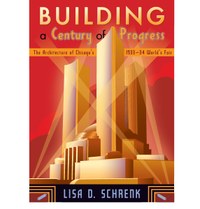
From the summer of 1933 to the fall of 1934, more than 38 million fairgoers visited Chicago's second World's Fair. Millions more experienced the Century of Progress International Exposition through newspaper and magazine articles, newsreels, and souvenirs. In the richly illustrated Building a Century of Progress, Lisa D. Schrenk explores the pivotal role of the 1933 Chicago World's Fair in modern American architecture.
Richly illustrated and comprehensive, Lisa Schrenk’s book demonstrates to fan and scholar alike the importance and influence of the 1933 Chicago World’s Fair.
Kevin Harrington, coauthor of Chicago’s Famous Buildings
From the summer of 1933 to the fall of 1934, more than 38 million fairgoers visited a 3-mile stretch along Lake Michigan, home to Chicago’s second World’s Fair. Millions more experienced the Century of Progress International Exposition through newspaper and magazine articles, newsreels, and souvenirs. Together, all marveled at the industrial, scientific, consumer, and cultural displays, many of which were housed in fifty massive and colorful exhibition halls, the largest architectural project realized in the United States during the Great Depression.
In the richly illustrated Building a Century of Progress, Lisa D. Schrenk explores the pivotal role of the 1933 Chicago World’s Fair in modern American architecture. She recounts how the exposition’s architectural commission promoted a broad definition of modern architecture, not relying on purely aesthetic characteristics but instead focusing on new design solutions. The fair’s pavilions incorporated recently introduced building materials such as masonite and gypsum board; structural innovations (for example, the first thin-shell concrete roof and the first suspended roof structures built in the United States); and new construction processes, most notably the use of prefabrication. They also featured curiosities like the giant, constantly operating mayonnaise maker and the glass-walled House of Tomorrow, which had no operable windows. Schrenk shows how the halls’s designs reflected cultural and political developments of the period, including the expanding relationships between science, industry, and government; the rise of a corporate consumer culture; and the impact of the Great Depression.
Many of the designs provoked intense responses from critics and other prominent architects, including Frank Lloyd Wright and Ralph Adams Cram, fueling heated debates over the appropriate direction for architecture in the United States. Demonstrating the rich diversity of progressive American building design seen at the fair, Building a Century of Progress captures a crucial moment in American modernism.
Richly illustrated and comprehensive, Lisa Schrenk’s book demonstrates to fan and scholar alike the importance and influence of the 1933 Chicago World’s Fair.
Kevin Harrington, coauthor of Chicago’s Famous Buildings
A valuable and important contribution, Building a Century of Progress will cause scholars to refocus and rethink their assumptions about the fairs of the 1930s. It is the first detailed architectural history of any of the American fairs of the interwar period.
Robert Rydell, author of Fair America: World's Fairs in the United States
Schrenk provides a good discussion of the debates on modern architecture that surrounded the design of the fair.
Publishers Weekly
A well-illustrated thoughtfully written account that’s as accessible to a general audience as to a professional one.
Chicago Tribune
An engaging and wide-ranging study. A marvelous gallery of color images supports an important assessment of the role of color in architectural theory of the era.
Choice
Handsomely illustrated.
Chronicle of Higher Education
It is hard to imagine a more thorough examination of the amazing success of this World’s Fair in the midst of the Depression. The author’s careful scholarship is documented through the numerous footnotes, impressive bibliography and many illustrations of both built and unbuilt projects. Yet the book reads easily and well for the casual reader interested in learning what a visitor to the Fair could expect to experience.
Chicago Art Deco Society Magazine
The book is an invaluable resource. This book can well grace any coffee table, but is much more than just a pretty face.
Windy City Times
Building a Century of Progress is a well-researched, well-written, and well-illustrated book . . . This book is valuable for its comprehensive presentation of the Century of Progress as an advertising mechanism demonstrating the possibilities of modern architecture to the wider public, and for its focus on new building technologies.
Technology and Culture
Lisa D. Schrenk’s Building a Century of Progress: The Architecture of Chicago’s 1933-34 World’s Fair is a rarity: a scholarly book that’s a lot of fun to read. The author has a knack for details that make the vintage photos come alive, giving a remarkably vivid sense of strolling the fair’s grounds and exhibits . . . Anyone who is truly familiar with the Century of Progress is one of two things: they’re nearly a hundred years old or they’ve just finished this fascinating book.
Modernism Magazine
The details of attendance, the variety of the exhibits, the comings and goings of the layman and the rich and famous are all noted, and in an engaging way, but it is the group of illustrations, particularly from the author’s own rich and substantial postcard collection, that really makes this book a treasure for both the scholar, the fair buff, and the general reader. Plans settings, individual buildings and exhibits, maps, and comparisons are laid out clearly and effectively, and the whole is both intellectually and visually appealing as the Fair itself.
Journal of American Cultures
In Building a Century of Progress, architectural historian Lisa D. Schrenk gives us a profusely illustrated book on one Fair that is both informative to read and fun to examine . . . An enjoyable book.
Leonardo Reviews
Contents
acknowledgments
introduCtion The Future Begins
one Science Finds—Industry Applies—Man Conforms
two Designing the City of Color and Delight
three Prefabricated Palaces: Formal Designs of the Pavilions
four Building Innovations at the Exposition
five Exposition Houses of Today and Tomorrow
six Unbuilt Visions for a Modern Exposition
seven The Contemporary Reaction and Impact of the Exposition
PostsCriPt The Curtain Falls
appendix a Major Buildings and Architects of A Century of Progress
appendix b Color Schemes of A Century of Progress
notes
bibliography
index
Related Publications



 Progressive Design in the Midwest
The Purcell-Cutts House and the Prairie School Collection at the Minneapolis Institute of Arts
Progressive Design in the Midwest
The Purcell-Cutts House and the Prairie School Collection at the Minneapolis Institute of Arts