The Voice of Southern Labor
Radio, Music, and Textile Strikes, 1929-1934
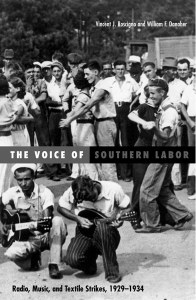
The Voice of Southern Labor chronicles the experiences of southern textile workers and provides a unique perspective on the social, cultural, and historical forces that came into play when the group struck in 1934. The workers’s grievances and solidarity were reflected in the music they listened to and sang, and this book offers a context for this intersection of labor, politics, and culture.
The Voice of Southern Labor examines and illuminates an important, but not well-documented, strike and thus contributes significantly to the study of labor history as well as to the broader study of collective action.
David A. Snow, University of California, Irvine
The 1934 strike of southern textile workers, involving nearly 400,000 mill hands, remains perhaps the largest collective mobilization of workers in U.S. history. How these workers came together in the face of the powerful and coercive opposition of management and the state is the remarkable story at the center of this book.
The Voice of Southern Labor chronicles the lives and experiences of southern textile workers and provides a unique perspective on the social, cultural, and historical forces that came into play when the group struck, first in 1929, and then on a massive scale in 1934. The workers’s grievances, solidarity, and native radicalism of the time were often reflected in the music they listened to and sang, and Vincent J. Roscigno and William F. Danaher offer an in-depth context for understanding this intersection of labor, politics, and culture.
The authors show how the message of the southern mill hands spread throughout the region with the advent of radio and the rise of ex–mill worker musicians, and how their sense of opportunity was further bolstered by Franklin D. Roosevelt’s radio speeches and policies.
Music played an important role in mobilization. The authors’s account of the music and the musicians is rich in detail and provides exciting and interesting insight into the significance of music to social movements.
Work and Occupations
The Voice of Southern Labor is an important contribution that offers a highly engaging analysis of Depression-era mobilization in the textile mills of the southern United States. This compact and readable book connects micro-level processes of identity formation to the development of oppositional culture and collective action.
International Review of Social History
The 1934 strike of southern textile workers remains perhaps the largest collective mobilization of workers in U.S. history. How these workers came together in the face of the powerful and coercive opposition of management and the state is the remarkable story at the center of this book.
The Birmingham Times
The Voice of Southern Labor is an excellent book. Roscigno and Danaher write in clear and lively prose throughout, and their inclusion of quotations, lyrics, and pictures at various points in the book brings human faces and voices to their description and explanation.
Mobilization
Excellent, well-written sociological study. Highly recommended.
Choice
This book makes a real contribution to the fields of labor and working class studies and sociology. Understanding and organizing the South is critical for the revitalization and long term health of the labor movement.
Labor Studies Journal
The authors argue persuasively for the importance of cultural resources in the shaping of workers’s responses to working and living conditions.
Labour/Le Travail
A fascinating look at labor resistance. The Voice of Southern Labor makes a noteworthy contribution to understanding the evolution of the textile strikes of the Depression era. Specifically, it draws much needed attention to southern workers’s indigenous radicalism and class consciousness, rendering implausible analyses of low unionization in the south based on an absence of class consciousness.
Labor History
The Voice of Southern Labor examines and illuminates an important, but not well-documented, strike and thus contributes significantly to the study of labor history as well as to the broader study of collective action.
David A. Snow, University of California, Irvine
The book is a vivid reminder of the deplorable working conditions that created the need for organized labor, a remarkably prescient instance of the power and the pitfalls of social movement unionism, and a commentary on the inadequacy of business model unionism.
Anthropology of Work Review
Contents
Preface
Introduction
1. The World of the Southern Cotton Mill
2. Radio in the Textile South
3. The People’s President
4. The Musicians
5. Music and the Mill Experience
6. Mill-Worker Consciousness, Music, and the Birth of Revolt
7. The General Textile Strike of 1934
Conclusion
Notes
Bibliography
Index