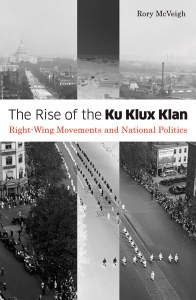
The Rise of the Ku Klux Klan
Right-Wing Movements and National Politics
Rory McVeigh provides a revealing analysis of the broad social agenda of 1920s-era KKK, showing that although the organization continued to promote white supremacy, it targeted immigrants and, particularly, Catholics, as well as African Americans, as dangers to American society. In sharp contrast to earlier studies of the KKK, McVeigh treats the Klan as it saw itself—as a national organization concerned with national issues.
McVeigh’s careful analysis of Klan mobilization breaks new ground in explaining why the 1920s Klan was massive and powerful in some areas of the U.S. and barely visible in others. Essential reading for understanding political movements of fear and bigotry.
Kathleen M. Blee, author of Inside Organized Racism: Women in the Hate Movement
In 1915, forty years after the original Ku Klux Klan disbanded, a former farmer, circuit preacher, and university lecturer named Colonel William Joseph Simmons revived the secret society. By the early 1920s the KKK had been transformed into a national movement with millions of dues-paying members and chapters in all of the nation’s forty-eight states. And unlike the Reconstruction-era society, the Klan in the 1920s exerted its influence far beyond the South.
In The Rise of the Ku Klux Klan, Rory McVeigh provides a revealing analysis of the broad social agenda of 1920s-era KKK, showing that although the organization continued to promote white supremacy, it also addressed a surprisingly wide range of social and economic issues, targeting immigrants and, particularly, Catholics, as well as African Americans, as dangers to American society. In sharp contrast to earlier studies of the KKK, which focus on the local or regional level, McVeigh treats the Klan as it saw itself—as a national organization concerned with national issues. Drawing on extensive research into the Klan’s national publication, the Imperial Night-Hawk, he traces the ways in which Klan leaders interpreted national issues and how they attempted—and finally failed—to influence national politics.
More broadly, in detailing the Klan’s expansion in the early 1920s and its collapse by the end of the decade, McVeigh ultimately sheds light on the dynamics that fuel contemporary right-wing social movements that similarly blur the line between race, religion, and values.
McVeigh’s careful analysis of Klan mobilization breaks new ground in explaining why the 1920s Klan was massive and powerful in some areas of the U.S. and barely visible in others. Essential reading for understanding political movements of fear and bigotry.
Kathleen M. Blee, author of Inside Organized Racism: Women in the Hate Movement
As fast as work on social movements has proliferated in recent years, movements on the right have continued to receive short shrift. But that is just one reason to celebrate McVeigh’s exhaustive study of the Klan. McVeigh broadens our understanding of the Klan by highlighting a host of other issues besides race—immigration, economics, religion—that helped fuel their meteoric rise to power in the mid-1920s.
Doug McAdam, Stanford University
Rory McVeigh’s study of Ku Klux Klan growth in the 1920s rejects ‘deviance’ and other established sociological theories in providing a new turn to the understanding of right-wing movements. His analysis is concerned with middle class people under the pressure of economic, political, and status-loss power devaluation in a changing society.
David Chalmers, author of Backfire: How the Ku Klux Klan Helped the Civil Rights Movement
McVeigh does an excellent job of describing a dramatically changing America and the Klan that rose in response.
Multicultural Review
The textual richness and evocative detail of McVeigh’s book make it an essential read for students of conservative activism and for those seeking a reflective exploration of one of the most significant social movements in U.S. history.
Journal of Southern History
McVeigh’s book offers an empirically rich and theoretically compelling account of Klan activism specifically and right-wing mobilization generally.
Social Forces
The Rise of the Ku Klux Klan is interesting, the argument well developed, and the evidence convincing. The book is important not only for its well-developed theory, but also because it is one of the few monographs on right-wing mobilization.
American Journal of Sociology
The Rise of the Ku Klux Klan is more than engrossing social history. It is also McVeigh’s most comprehensive application of the power-devaluation theory of right-wing social movements. [His] book is an excellent example of good social science research that blends quantitative and nonquantitative evidence to tell an interesting and important story. It is nicely written, in a style that makes it very accessible to a broad readership; is a welcomed addition to the social movements literature; and is a major theoretical statement by its author.
Contemporary Sociology
This book is a significant contribution to the social movements and KKK literature.
Ethnic and Racial Studies
Theoretically ambitious and methodologically diverse, The Rise of the Ku Klux Klan is an important work that deserves a wide readership.
Social Movement Studies
This impressive and accessible book is of interest to anyone what wants to understand how right-wing social and political movements mobilize constituencies, recruit members, and influence local and national politics.
e-Extreme
Welcome and thought-provoking.
H-Net
This is an important work on a historical right-wing movement with clear applications for understanding tea parties and anti-immigrant movements today.
American Studies
As the book is well documented, it manages to place its subject at the rightful place in the American society, laying a proper emphasis not only on the basic triggers of its existence, but also on the echoes and sequels it can provoke.
CEU Political Science Journal
Contents
1. The Klan as a National Movement
2. The Rebirth of a Klan Nation, 1915–1924
3. Power Devaluation
4. Responding to Economic Change: Redefining Markets along Cultural Lines
5. National Politics and Mobilizing “100 Percent American” Voters
6. Fights over Schools and Booze
7. How to Recruit a Klansman
8. Klan Activism across the Country
9. The Klan’s Last Gasp: Campaigning to Keep a Catholic out of the White House, 1925–1928
Conclusion: Right-Wing Movements, Yesterday and Today
Acknowledgments
Notes
Works Cited
Index