Poison Woman
Figuring Female Transgression in Modern Japanese Culture
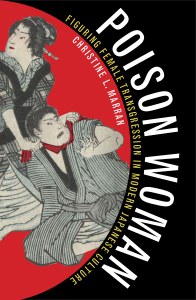
Based on the lives and crimes of no less than twenty real women, dokufu (poison women) narratives emerged as a powerful presence in Japan during the 1870s. In Poison Woman, Christine L. Marran investigates this powerful icon, its shifting meanings, and its influence on defining women's sexuality and place in Japan.
Poison Woman is a remarkable project, original and important. Marran's work makes essential reading for anyone interested in the transformations of sexuality, gender, and literature in modern Japan.
Michael K. Bourdaghs, author of The Dawn that Never Comes: Shimazaki Toson and Japanese Nationalism
Based on the lives and crimes of no less than twenty real women, dokufu (poison women) narratives emerged as a powerful presence in Japan during the 1870s. During this tumultuous time, as the nation moved from feudalism to oligarchic government, such accounts articulated the politics and position of underclass women, sexual morality, and female suffrage. Over the next century, the figure of the oversexed female criminal, usually guilty of robbery or murder, became ubiquitous in modern Japanese culture.
In Poison Woman, Christine L. Marran investigates this powerful icon, its shifting meanings, and its influence on defining women’s sexuality and place in Japan. She begins by considering Meiji gesaku literature, in which female criminality was often medically defined and marginalized as abnormal. She describes the small newspapers (koshinbun) that originally reported on poison women, establishing journalistic and legal conventions for future fiction about them. She examines zange, or confessional narratives, of female and male ex-convicts from the turn of the century, then reveals how medical and psychoanalytical literature of the 1920s and 1930s offered contradictory explanations of the female criminal as an everywoman or a historical victim of social circumstances and the press. She concludes by exploring postwar pulp fiction (kasutori), film and underground theater of the 1970s, and the feminist writer Tomioka Taeko’s take on the transgressive woman.
Persistent stories about poison women illustrate how a few violent acts by women were transformed into myriad ideological, social, and moral tales that deployed notions of female sexual desire and womanhood. Bringing together literary criticism, the history of science, media theory, and gender and sexuality studies, Poison Woman delves into genre and gender in ways that implicate both in projects of nation-building.
Poison Woman is a remarkable project, original and important. Marran's work makes essential reading for anyone interested in the transformations of sexuality, gender, and literature in modern Japan.
Michael K. Bourdaghs, author of The Dawn that Never Comes: Shimazaki Toson and Japanese Nationalism
Poison Woman marks a new and exciting kind of scholarship in Japanese literary and feminist studies. There is simply nothing like it.
Jan Bardsley, University of North Carolina at Chapel Hill
Marran covers a lot of ground in showing how the iconic poison woman is central to the formation of the female subject. Recommended.
Choice
Poison Woman is an intriguing and rigorous study that will be of great interest to anyone studying in the area of Japanese literature or popular culture. At the same time, due to its user-friendly structure and readability, this is a good book for anyone who wants to learn something new about a topic they may never have encountered before.
M/C Reviews
Poison Woman skillfully reconstructs fascinating tales from long ago, accompanied by wonderful stories and vivid illustrations. An extremely enjoyable read.
NWSA Journal
Given the readability and depth of Marran’s writing, Poison Woman would make a superb companion to any class that deals with Meiji or twentieth-century discourses of gender, science, or literary theory.
Journal of Japanese Studies
Poison Woman exemplifies the fine scholarship that can result from an interdisciplinary approach combining literary and media criticism, critical theory and gender analysis, and historiography. Marran’s analysis is not only far-reaching, but insightful.
Asian Studies Review