Drug Wars
The Political Economy of Narcotics
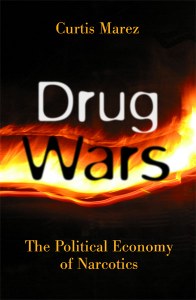
In Drug Wars, cultural critic Curtis Marez examines two hundred years of writings, graphic works, films, and music that both demonize and celebrate the commerce in cocaine, marijuana, and opium, providing a bold interdisciplinary exploration of drugs in the popular imagination. Throughout Marez juxtaposes official drug policy and propaganda with subversive images that challenge and sometimes even taunt government and legal efforts.
Drug Wars is a bold and imaginative book that puts the cultural narratives of opium, cocaine, and marijuana trade and consumption into a compelling geopolitical context.
Nayan Shah, author of Contagious Divides: Epidemics and Race in San Francisco's Chinatown
Inaugurated in 1984, America's "War on Drugs" is just the most recent skirmish in a standoff between global drug trafficking and state power. From Britain's nineteenth-century Opium Wars in China to the activities of Colombia's drug cartels and their suppression by U.S.-backed military forces today, conflicts over narcotics have justified imperial expansion, global capitalism, and state violence, even as they have also fueled the movement of goods and labor around the world.
In Drug Wars, cultural critic Curtis Marez examines two hundred years of writings, graphic works, films, and music that both demonize and celebrate the commerce in cocaine, marijuana, and opium, providing a bold interdisciplinary exploration of drugs in the popular imagination. Ranging from the writings of Sigmund Freud to pro–drug lord Mexican popular music, gangsta rap, and Brian De Palma's 1983 epic Scarface, Drug Wars moves from the representations and realities of the Opium Wars to the long history of drug and immigration enforcement on the U.S.-Mexican border, and to cocaine use and interdiction in South America, Middle Europe, and among American Indians. Throughout Marez juxtaposes official drug policy and propaganda with subversive images that challenge and sometimes even taunt government and legal efforts.
As Marez shows, despite the state's best efforts to use the media to obscure the hypocrisies and failures of its drug policies—be they lurid descriptions of Chinese opium dens in the English popular press or Nancy Reagan's "Just Say No" campaign—marginalized groups have consistently opposed the expansion of state power that drug traffic has historically supported.
Drug Wars is a bold and imaginative book that puts the cultural narratives of opium, cocaine, and marijuana trade and consumption into a compelling geopolitical context.
Nayan Shah, author of Contagious Divides: Epidemics and Race in San Francisco's Chinatown
Drug Wars is to be fundamentally praised for the generation, germination, and marvelous flowering of its brilliant and original central idea: the discursive and complicit role of drugs in the extension of colonial power.
Jose E. Limon, University of Texas at Austin
Drug Wars is an engaging cultural studies history of opium, marijuana, and cocaine. Drug Wars is an often brilliant but always challenging monograph whose central thesis is that drug enforcement cannot be segregated from issues of state power and economic interest. This book merits serious attention from scholars, policy analysts, and lawmakers.
Journal of Popular Culture
The author seeks to compare popular culture and government images of the drug trade and war on drugs. Marez shows how government policy, propaganda, entertainment media and cultural mores all intertwine—and have for some years.
Communication Booknotes Quarterly
Marez’s Drug Wars trace how and why particular groups of American—police, immigrant laborers, psychiatrists—worked to establish drugs as a public spectacle, infusing them with intense and often contradictory political valences. In Drug Wars, drugs provide a compelling imperial morality tale—a velvet glove to mask the iron fist-and a potentially inspiring symbol of rebellion.
American Quarterly
Contents
Preface and Acknowledgments
Introduction: Drug Wars
Part I. Opium
1. The Globe in an Opium Bowl: The Opium Wars and British Empire in Asia
2. Strange Bedfellows: Opium and the Political Economy of Sexuality
Part II. Marijuana
3. Anarchy in the USA: The Mexican Revolution, Labor Radicalism, and the Criminalization of Marijuana
4. LAPD, the Movie: Hollywood, the Police, and the Drug War against Mexican Immigrants
5. La Cucaracha in Babylon: Mexican Music and Hollywood’s Sonic War on Drugs
Part III. Cocaine
6. Cocaine Colonialism: Indian Rebellion in South America and the History of Psychoanalysis
7. Drug Wars Are Indian Wars: Frontier Drug Enforcement and the Ends of U.S. Empire
Notes
Index