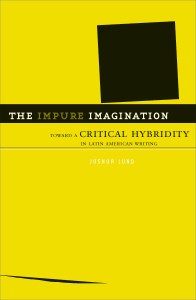
The Impure Imagination
Toward a Critical Hybridity in Latin American Writing
In this pathbreaking work, Joshua Lund offers a thoughtful critique of hybridity by reading contemporary theories of cultural mixing against their historical precursors. Using the emergence of hybridity as an analytical frame for thinking about culture in the Americas, Lund examines the contributions of influential thinkers, including Néstor García Canclini, Homi Bhabha, Jacques Derrida, Giorgio Agamben, Jorge Luis Borges, Antonio Candido, and many others.
The Impure Imagination offers an unparalleled overview of the discourses on hybridity in Latin American critical writing and, most crucially, an analysis of hybridity as discourse.
Juan Poblete, editor of Critical Latin American and Latino Studies
“Hybridity” is a term that has been applied to Latin American politics, literature, and intellectual life for more than a century. During the past two decades, it has figured in—and been transfigured by—the work of prominent postcolonialist writers and thinkers throughout the Americas.
In this pathbreaking work, Joshua Lund offers a thoughtful critique of hybridity by reading contemporary theories of cultural mixing against their historical precursors. The Impure Imagination is the first book to systematically analyze today’s dominant theories in relation to earlier, narrative manifestations of hybridity in Latin American writing, with a particular focus on Mexico and Brazil.
Generally understood as the impurification of standard or canonized forms, hybridity has historically been embraced as a basic marker of Latin American regional identity and as a strategy of resistance to cultural imperialism. Lund contends that Latin American theories and narratives of hybridity have been, and continue to be, underwritten by a structure of colonial power. Here he provides an informed critique and cogent investigation of this connection, its cultural effects, and its political implications. Using the emergence of hybridity as an analytical frame for thinking about culture in the Americas, Lund examines the contributions of influential thinkers, including Néstor García Canclini, Homi Bhabha, Jacques Derrida, Giorgio Agamben, Jorge Luis Borges, Antonio Candido, and many others.
Distinguished by its philosophical grounding and underpinned with case studies, The Impure Imagination employs postcolonial theory and theories of race as it explores Latin American history and culture. The result is an original and interrogative study of hybridity that exposes surprising—and unsettling—similarities with nationalistic discourses.
The Impure Imagination offers an unparalleled overview of the discourses on hybridity in Latin American critical writing and, most crucially, an analysis of hybridity as discourse.
Juan Poblete, editor of Critical Latin American and Latino Studies
This study contributes to the ongoing debate over colonialism in Latin American literature. Recommended.
Choice
Lund lays out a series of historically grounded, critical interpretations of Latin American ‘hybridology’ that surpass anything I know of in the field of contemporary Latin-Americanism.
A Contra corriente
This is a book that goes far beyond its stated remit to critically examine discourse of hybridity in Latin American writing and offers a challenge to the conceits and assumptions of so many working within the field of Latin American studies today such that it prompts a rethinking of what actually constitutes and distinguishes this field of study.
Bulletin of Hispanic Studies