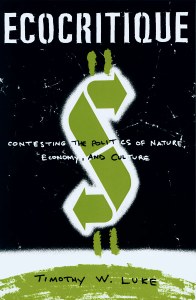
Ecocritique
Contesting the Politics of Nature, Economy, and Culture
Timothy Luke exposes how ecological critics, organizations, and movements manipulate our conception of the environment. Turning the tables on the ecocritics, Luke demonstrates how ecocriticism can move beyond its familiar confines to engage larger cultural, economic, and political questions.
“Tim Luke has emerged as one of the most exciting writers on global politics today.” --Scott Lash, Lancaster University
Tim Luke has emerged as one of the most exciting writers on global politics today. Shifting registers from the sociality of cyberspace, in Ecocritique Luke addresses the natural realm. Luke’s book is an ecocritique of the ecological critics: both of the thinkers and the social movements. Challenging notions of biosystemic equilibrium, Luke reexplores ecology through recasting the aggregate of human/machine, human/animal and human/plant relations. Luke is the green movement’s deep technophile.
Scott Lash, Lancaster University
Ecocriticism, whether coming from “back to nature” conservatives, Nature Conservancy liberals, or Earth First! radicals, is familiar enough. But when we listen do we really hear what these groups are saying? In a book that examines the terms of ecocriticism, Timothy W. Luke exposes how ecological critics, organizations, and movements manipulate our conception of the environment. Turning the tables on the ecocritics, Luke demonstrates how ecocriticism can move beyond its familiar confines to engage larger cultural, economic, and political questions.
Ecocritique rereads ecocriticism to reveal how power and economy, society and culture, community and technology compete over what are now widely regarded as the embattled ecosystems of nature. Luke considers in particular how the meanings and values attached to the environment by various groups—from the Worldwatch Institute, the Nature Conservancy, and Earth First! to proponents of green consumerism, social ecology, and sustainable development—articulate new visions of power and subjectivity for a post-Cold War era.
This accessibly written work opens with deep ecology and concludes with social ecology, along the way reconsidering thinkers with green philosophical leanings, including Herbert Marcuse, Paolo Soleri, and Murray Bookchin. In systematic critiques reexamining the cultural practices and ethical values of contemporary environmentalism, Luke highlights the political dilemmas of biocentrism and anthropocentrism in modern ecological thinking.
With its critical analysis of many contemporary environmental discourses and organizations, Ecocritique makes a major contribution to ongoing debates about the political relationships among nature, culture, and economics in the current global system.
Tim Luke has emerged as one of the most exciting writers on global politics today. Shifting registers from the sociality of cyberspace, in Ecocritique Luke addresses the natural realm. Luke’s book is an ecocritique of the ecological critics: both of the thinkers and the social movements. Challenging notions of biosystemic equilibrium, Luke reexplores ecology through recasting the aggregate of human/machine, human/animal and human/plant relations. Luke is the green movement’s deep technophile.
Scott Lash, Lancaster University
Ecocritique offers fresh and lively insights of contemporary environmental discourses. The result is an engaging account of the different ‘environments’ imagined by such divergent ecological critics as Earth First!, the Nature Conservancy, and Murray Bookchin.
Environment and Planning A
Ecocritique provides a stimulating dialogue on the status of current and future environmental policy in industrialized societies.
Rhetoric and Public Affairs
Adroit students of environmental issues and lost fans of Marxist analysis should read this book for several reasons. First, Luke offers relief from paralyzing inertia of contemporary analyses of sky-is-falling: pollution is replete: resource are inexorably deplete: fatalism of so called ‘crackpot, limousine liberals willing to put the existence of snail-darters before modern humanities’ material progress. Ecocritique offers full histories, complete organizational models, and refreshing, pithy analysis directed toward constructing an effective environmental agenda.
Theory and Event
Luke utilizes critical theory in a powerful way, exposing the failures of apolitical and liberal environmental discourses to deal with the institutional roots of the environmental crisis that lie in a capitalist economy predicated on insatiable growth imperatives.
Terra Nova
This book is extremely stimulating for discussion. It would be very well-suited for any group that would like to discuss issues involved with nature conservation and ecological politics.
The Prairie Naturalist