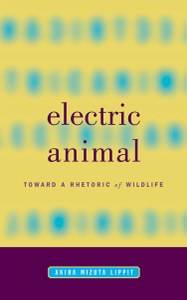
Electric Animal
Toward a Rhetoric of Wildlife
Akira Mizuta Lippit shows us the animal as a crucial figure in the definition of modernity—essential to developments in the natural sciences and technology, radical transformations in modern philosophy and literature, and the advent of psychoanalysis and the cinema.
At the center of some of the most important theoretical and philosophical debates currently underway, Electric Animal is a tremendously intriguing and fascinating piece of work that will have a considerable impact.
Christopher Fynsk, State University of New York, Binghamton
Differentiation from animals helped to establish the notion of a human being, but the disappearance of animals now threatens that identity. This is the argument underlying Electric Animal, a probing exploration of the figure of the animal in modern culture. Akira Mizuta Lippit shows us the animal as a crucial figure in the definition of modernity—essential to developments in the natural sciences and technology, radical transformations in modern philosophy and literature, and the advent of psychoanalysis and the cinema.
Moving beyond the dialectical framework that has traditionally bound animal and human being, Electric Animal raises a series of questions regarding the idea of animality in Western thought. Can animals communicate? Do they have consciousness? Are they aware of death? By tracing questions such as these through a wide range of texts by writers ranging from Friedrich Nietzsche to Jacques Derrida, Sigmund Freud to Vicki Hearne, Lewis Carroll to Franz Kafka, and Sergei Eisenstein to Gilles Deleuze, Lippit arrives at a remarkable thesis, revealing an extraordinary logical consensus in Western thought: animals do not have language and hence cannot die.
The animal has, accordingly, haunted thought as a form of spectral and undead being. Lippit demonstrates how, in the late nineteenth century, this phantasmic concept of animal being reached the proportions of an epistemological crisis, engendering the disciplines and media of psychoanalysis, modern literature, and cinema, among others. Against the prohibitive logic of Western philosophy, these fields opened a space for rethinking animality. Technology, usually thought of in opposition to nature, came to serve as the repository for an unmournable animality-a kind of vast wildlife museum.
A highly original work that charts new territory in current debates over language and mortality, subjectivity and technology, Electric Animal brings to light fundamental questions about the status of representation—of the animal and of ourselves—in the age of biomechanical reproduction.
At the center of some of the most important theoretical and philosophical debates currently underway, Electric Animal is a tremendously intriguing and fascinating piece of work that will have a considerable impact.
Christopher Fynsk, State University of New York, Binghamton
A large-scale re-evaluation of our cultural and intellectual history in order to understand how people and animals have coexisted through the centuries. Lippit re-examines the touchstones of Western intellectual development. In a dazzling interdisciplinary romp through Aristotle, Heidegger, Darwin, Freud, and up to the present with a discussion of Kafka, photography, and cinema, Lippit is keenly aware of how, throughout history, people have condescended toward animals—the flip side of valuing humanity above all else. Lippit deconstructs the masking of animal consciousness in our intellectual traditions.
Randy Malamud, Chronicle of Higher Education Review
Lippit traces the career of the animal from Aristotle to Derrida, via Rousseau, Nietzsche, Heidegger, and the usual suspects, and tracks it to a wild new landscape that is still emerging. What Lippit pulls off in Electric Animal is, weirdly, the bringing together of nature and artifice in their joint opposition to language. Language is supposed to go with artifice, and with what is human, against what is natural, and what is animal. What is profound about this reshuffling of the metaphysical deck is the trick card it turns up. It’s a portal to thinking otherwise. Lippit’s last speculation points way beyond the confines of this meticulous little book.
McKenzie Wark, Artbyte
This book is, among other things, an extraordinarily promising preface to a, perhaps the, theory of cinema.
MLN
In Electric Animal, Akira Mizuta Lippit takes up the simultaneously urgent and impervious question of animality. He comes to the animal, to interrogate the animal, to circumscribe and solicit the elusive theme of the animal through a manifold strategy-retrieving pertinent remarks in the folds and margins of philosophico-metaphysical discourses. Lippit’s text, which may hereafter serve as a landmark for further research on the subject, offers moments of incisive analysis while spanning heterogeneous debates with remarkable agility.
Bryn Mawr Review of Comparative Literature
This excellent, comprehensive overview and stimulating discussion that is intensely rewarding in its final, speculative moments will be of interest to many readers interested in different fields of inquiry, be it philosophy, psychoanalysis, ecology, ethics, cinema, or media studies.
Semiotic Review of Books
Lippit provides an illuminating recapitulation of Western thought.
Canadian Literature
One of the best compliments. . . one can address to this hallmark publication is that it deserves a readership as varied as the issues and disciplines it tackles. Lippit ought to be read by philosophers and cultural historians, obviously, but his work should be no less carefully discussed by scholars of visual culture, cinema, photography, and literature.
Leonardo Reviews