Postcolonial Dublin
Imperial Legacies and the Built Environment
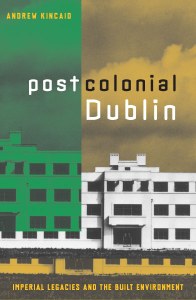
Postcolonial Dublin shows how perpetrators of colonialism in Ireland have made use of urban planning and architecture to underscore and legitimate ideologies. Looking at objects such as Londonderry's Market House, Patrick Abercrombie's Dublin of the Future, and the urban renewal project of today's Temple Bar, Andrew Kincaid highlights Ireland's colonial history and the significance of architecture in the evolution of national identity.
Postcolonial Dublin is an important, even provocative, work.
Seamus Deane, author of Foreign Affections: Essays on Edmund Burke
For hundreds of years, Ireland has been a testing ground for colonizing techniques. Postcolonial Dublin shows how perpetrators of colonialism have made use of urban planning and architecture to underscore and legitimate ideologies. From suburban development to building facades, the conflict between nationalists and colonialists has inscribed itself on Dublin’s landscape.
Andrew Kincaid illustrates how the architecture and urban planning of Dublin have been integral to debates about nationalism, modernism, and Ireland’s relationship to the rest of the world. Looking at objects such as Londonderry’s Market House, Patrick Abercrombie’s Dublin of the Future, and the urban renewal project of today’s Temple Bar, Kincaid highlights Ireland’s colonial history and the significance of architecture in the evolution of national identity. In doing so, he demonstrates how ideology “spatializes” itself.
Postcolonial Dublin engages the prevailing historical representations of Irish nationalism, arguing that the evolving city reflected a debate over who would hold the reins of power. Bringing the tools of literary criticism and postcolonial theory to bear on the field of urban studies, Kincaid places Dublin at the forefront of debates over modernism, modernity, and globalization.
Postcolonial Dublin is an important, even provocative, work.
Seamus Deane, author of Foreign Affections: Essays on Edmund Burke
The book is a gold mine of research into some of the more important and controversial construction projects undertaken since Ireland became a nation-state in 1922. Kincaid’s thesis makes for an interesting and timely corrective to the dominant paradigm in Irish Studies. He launches a promising beginning to the pressing work of investigating the multiple aspects of Ireland’s engineering cultures, too long neglected.
Field Day Review
Postcolonial Dublin offers the reader a sustained examination of the significance of space in the development of Dublin during the twentieth century. Postcolonial Dublin is an important book and the author is to be commended for bringing to Irish Studies scholarship a more overtly spatial approach to understand Ireland and Dublin.
Irish Geography
Complicates our understanding of how imperial and national authorities have consolidated and maintained power in Ireland. A compelling reading of the city that supplements previous depictions of Ireland’s relationship to modernity. While focusing on Dublin’s architecture and urban planning in the twentieth century, the scope of Kincaid’s book encompasses a field of interest much larger than Irish Studies. Postcolonial Dublin succeeds in showing the various movements and concerns represented by Dublin’s urban geography; by tracing the physical changes in the city, Kincaid explains how these plans are tied up with attempts to rewrite the relationship between the past and the present. The rigor with which Kincaid works to take account of the multiplicity of voices that speak from Dublin’s built environment—especially his lucid explanation of modernity as the clash between the critical stance of artistic modernism and national schemes for industrial modernization—will interest scholars of Urban Studies, and more general scholars of the twentieth century as well.
New Hibernia Review
Kincaid weaves a compelling argument.
Journal of Urban Studies
Graced with handsome photographs, Kincaid’s book is a splendid addition to the burgeoning literature on Dublin. Postcolonial Dublin is one of the most exciting books on Ireland.
Textual Practice
Andrew Kincaid’s Postcolonial Dublin is a challenging and thoughtful work. . . . A timely and excellent reminder that urban geographies are of fundamental importance and this work contextualises the growth of Dublin within histories of urban planning and architecture while intervening in theoretical debates over postcolonialism and modernity.
Social and Cultural Geography