Making American Boys
Boyology and the Feral Tale
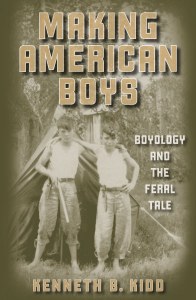
Making American Boys is a thorough review of boy culture in America since the late nineteenth century. From the “boy work” promoted by character-building organizations such as Scouting and 4-H to current therapeutic and pop psychological obsessions with children’s self-esteem, Kenneth B. Kidd presents the great variety of cultural influences on the changing notion of boyhood.
Kenneth Kidd’s Making American Boys is a remarkable pioneer study of the socio-cultural conditions that influenced the particular development of American boyhood from the late nineteenth century to the present. His study of the unique ‘feral tales’ about the taming and civilizing of wild boys, common in Europe and America, serves as an appropriate framework to analyze the tensions in the historical depiction and social treatment of prototype ‘perfect’ boys and marginalized boys in American society. Professor Kidd develops a most useful concept of boyology that reveals how boys have been worked on and molded through literature, self-help books, boy organizations, psychoanalysis, and other means of culture to form acceptable postures and behaviors. One major result is that wildness has in many ways been co-opted to produce so-called normal heterosexual men who are deemed the most worthy to represent American culture. This book is requisite reading for understanding how boys become ‘real’ American men.
Jack Zipes, professor of German, University of Minnesota
Will boys be boys? What are little boys made of? Kenneth B. Kidd responds to these familiar questions with a thorough review of boy culture in America since the late nineteenth century. From the “boy work” promoted by character-building organizations such as Scouting and 4-H to current therapeutic and pop psychological obsessions with children’s self-esteem, Kidd presents the great variety of cultural influences on the changing notion of boyhood.
Kidd finds that the education and supervision of boys in the United States have been shaped by the collaboration of two seemingly conflictive approaches. In 1916, Henry William Gibson, a leader of the YMCA, created the term boyology, which came to refer to professional writing about the biological and social development of boys. At the same time, the feral tale, with its roots in myth and folklore, emphasized boys’s wild nature, epitomized by such classic protagonists as Mowgli in The Jungle Books and Huck Finn. From the tension between these two perspectives evolved society’s perception of what makes a “good boy”: from the responsible son asserting his independence from his father in the late 1800s, to the idealized, sexually confident, and psychologically healthy youth of today. The image of the savage child, raised by wolves, has been tamed and transformed into a model of white, middle-class masculinity.
Analyzing icons of boyhood and maleness from Father Flanagan’s Boys Town and Max in Where the Wild Things Are to Elián González and even Michael Jackson, Kidd surveys films, psychoanalytic case studies, parenting manuals, historical accounts of the discoveries of “wolf-boys,” and self-help books to provide a rigorous history of what it has meant to be an all-American boy.
Kenneth Kidd’s Making American Boys is a remarkable pioneer study of the socio-cultural conditions that influenced the particular development of American boyhood from the late nineteenth century to the present. His study of the unique ‘feral tales’ about the taming and civilizing of wild boys, common in Europe and America, serves as an appropriate framework to analyze the tensions in the historical depiction and social treatment of prototype ‘perfect’ boys and marginalized boys in American society. Professor Kidd develops a most useful concept of boyology that reveals how boys have been worked on and molded through literature, self-help books, boy organizations, psychoanalysis, and other means of culture to form acceptable postures and behaviors. One major result is that wildness has in many ways been co-opted to produce so-called normal heterosexual men who are deemed the most worthy to represent American culture. This book is requisite reading for understanding how boys become ‘real’ American men.
Jack Zipes, professor of German, University of Minnesota
Making American Boys is an unusually important, highly intelligent, and formidably researched account of modern ‘boyology.’
Michael Moon, Johns Hopkins University
Making American Boys serves as a useful work of cultural history.
Journal of Interdisciplinary History
A strong cultural study. Fascinating stories that convince one the overarching significance of boys and boy work. The pleasure of Kidd’s archive, and of the tales and ideas he generates, is reason enough to pick up the book.
Criticism
Kidd makes a well-researched and interesting argument about the construction of middle-class white U.S. boyhood. Entertaining to read—especially to those who spend a lot of time thinking about where our ideas about gender and sex come from.
Clamor
Kidd offers fascinating evidence that ‘feral tales’ . . . seeped into the minds of childhood experts . . . indelibly marked the way we think about boyhood.
Village Voice
Disney honcho Michael Eisner has frequently attributed his success to lessons he learned as a boy at Vermont’s Camp Keewaydin. Those interested in a more scholarly analysis of summer camp, scouting, and other forms of ‘boy work’ can pick up University of Florida professor Kenneth B. Kidd’s Making American Boys: Boyology and the Feral Tale.
Boston Globe
Making American Boys is a wide-ranging study of boys and boy work—the YMCA, the Boy Scouts, popular literature, and film all get attention and analysis here. Kidd’s analysis makes use of various theoretical and practical lenses. Through those lenses, readers can see how our views on boys color so many other issues, including gender relations, anxieties about sexuality, and socioeconomic and racial questions.
Gay and Lesbian Review
In this fascinating study, Kidd argues that two ‘discourses’ have ‘shaped’ the education and supervision of boys in the U.S.: ‘boyology’. . . and the ‘feral tale.’ Highly recommended.
Choice
Kenneth B. Kidd’s fascinating and well-documented book, Making American Boys: Boyology and the Feral Tale, outlines two distinct patterns of representation that have constructed the image of the ‘boy’ in the nineteenth and twentieth centuries.
Journal of American Culture
In this engaging study, Kidd charts the evolution of arguments on what makes good boys and bad boys, finding that adult boyologists often tell us more about themselves and their society than they do about the boys under consideration. Kidd has done an excellent job producing a thoroughly researched account of how American boys become American men.
Men and Masculinities
Contents
Acknowledgments
Boyhood for Beginners: An Introduction
1. Farming for Boys
2. Bad Boys and Men of Culture
3. Wolf-Boys, Street Rats, and the Vanishing Sioux
4. Father Flanagan’s Boys Town
5. From Freud’s Wolf Man to Teen Wolf
6. Reinventing the Boy Problem
Notes
Works Cited
Index