Isherwood on Writing
The Complete Lectures in California

LISTEN: ON CHRISTOPHER ISHERWOOD'S CALIFORNIA LECTURES, WITH JAMES J. BERG, CHRIS FREEMAN, AND CLAUDE SUMMERS
Isherwood’s lectures on writing and writers, now all available for the first time in this updated edition
Isherwood on Writing assembles Christopher Isherwood’s free-flowing, wide-ranging public addresses from the 1960s to reveal a distinctly American Isherwood at the top of his form. This updated edition contains the long-lost conclusion to the second lecture, published here for the first time, including its discussion of A Single Man and A Meeting by the River, his final novel.
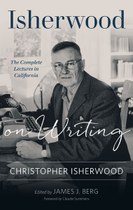
In the 1960s, Christopher Isherwood gave an unprecedented series of lectures at California universities on the theme “A Writer and His World.” During this time Isherwood, who would liberate the memoir and become the founding father of modern gay writing, spoke openly for the first time about his craft—on writing for film, theater, and novels—and on spirituality. Isherwood on Writing brings these public addresses together to reveal a distinctly—and surprisingly—American Isherwood.
Given at a critical time in Isherwood’s career, these lectures mark the era when he turned from fiction to memoir. In free-flowing, wide-ranging discussions, he reflects on such topics as why writers write, what makes a novel great, and what influenced his own work. Isherwood talks about his working relationship with W. H. Auden; his literary friendships with E. M. Forster, Virginia Woolf, Stephen Spender, Aldous Huxley, and Somerset Maugham; and his work in the film industry in London and Hollywood. He also explores uncharted territory in candid comments on his own work, something not contained in his diaries.
Isherwood on Writing uncovers an important and often-misunderstood time in Isherwood’s life in America. The lectures present, in James J. Berg’s words, “an example of a man, comfortable in his own sexuality and self, trying to talk about himself and his own life in a society that is not yet ready to hear the whole story.”
Christopher Isherwood’s two cycles of lectures about literature will be of interest to writers everywhere. He tells us how to write with realistic detail and moral engagement—and an almost godlike compassion. He encourages us to find our individual voice and to consult nothing but our own conscience. At every point he illustrates his points with examples from his own works as well as those by Melville, D. H. Lawrence, Flaubert, W. H. Auden and excerpts from the holy books of Hinduism. He is witty, self-effacing, worldly—but always extremely wise and nurturing.
Edmund White, author of A Boy’s Own Story
The book presents an interesting dichotomy of a man comfortable in his gay skin and able to discuss it, while the populace he divulges it to don’t grasp his intent.
Gay & Lesbian Times
As a diarist, Isherwood was funny, wry, astute—alternately compassionate and warm and hot and agitated, but never less than entertaining. Filled with poignant humor, gentle kindness, and, above all, nurturing love.
Choice
Highly recommended for both academic and community library biography, literary studies, and gay studies reference collections.
The Midwest Book Review
These lectures from the ‘60s hold fresh insights into the author’s life.
The Advocate
Isherwood on Writing brings home how profoundly a spiritual exercise writing was to Isherwood, and how joyful a one.
The Gay & Lesbian Review Worlwide
Contents
Foreword vii
Claude J. Summers
Editor’s Acknowledgments xvii
Introduction: The American Isherwood 1
James J. Berg
Part I. A Writer and His World, 1960 35
Influences 42
Why Write at All? 52
What Is the Nerve of Interest in the Novel? 64
What Is the Nerve of Interest in the Novel? (continued) 73
A Writer and the Theater 84
A Writer and the Films 99
A Writer and Religion 114
A Last Lecture 130
Part II. The Autobiography of My Books, 1963–65 143
All the Conspirators, The Memorial
The Berlin Stories
The Dog Beneath the Skin, Ascent of F6, On the Frontier
Prater Violet
The World in the Evening
Down There on a Visit
A Single Man
Ramakrishna and His Disciples, A Meeting by the River
Part III. Lecture Notes
A Writer and His World
Influences
Why Write at All?
What Is the Nerve of Interest in the Novel?
What Is the Nerve of Interest in the Novel? (continued)
A Writer and the Theater
A Writer and the Films
A Writer and Religion
A Last Lecture
Writers of the Thirties
The Novel As Experience
A Personal Statement
Voices of Novelists and Dramatists: Modern
What Is a Novel?
The Novel and the Novelist
Editor’s Notes
Index
In 1947, Gore Vidal sent a copy of his soon-to-be-published novel, The City and the Pillar, to a number of established writers. Christopher Isherwood was one of them.
Vidal, then 22, and his publishers expected negative press due to the book’s frank depiction of homosexuality. Isherwood, then 43, sent an appreciative letter to Vidal, but objected to the novel’s violent ending, in which the protagonist kills his high school obsession. For Isherwood, the book’s climax reinforced the public’s notion that gay men could not be happy and could not love one another. The American edition of The City and the Pillar was already published, however, and Vidal did not act on Isherwood’s advice. Years later, Vidal would revise the ending.