Reforming Welfare by Rewarding Work
One State’s Successful Experiment
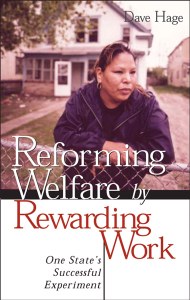
In the late 1980s, Governor Rudy Perpich gathered a group of citizen experts to redesign Minnesota’s welfare system, and a burst of innovation resulted in the groundbreaking and successful pilot Minnesota Family Investment Program (MFIP). Reforming Welfare by Rewarding Work intertwines MFIP’s development with harrowing—and enlightening—firsthand accounts of three families’s experiences on welfare, and asserts that a true antipoverty program is crucial—and achievable—in America.
We need a thousand books like this. Dave Hage tells the story both in moving human terms and in its policy and political detail. With public attention to welfare and poverty at a low ebb, this book will help move the issues back toward the front burner.
Peter Edelman, Professor of Law, Georgetown University Law Center and formerly Assistant Secretary for Planning and Evaluation, U.S. Department of Health and Human Services. (okay to edit bio.)
One of the most controversial and divisive issues in America, welfare reform stirs endless legislative study and heated debate but often results in political gridlock. Such was the case in the late 1980s when the Minnesota legislature came to a stalemate on the issue. In response, Governor Rudy Perpich gathered a group of citizen experts to redesign welfare, and a remarkable burst of innovation resulted in a groundbreaking and stunningly successful pilot welfare program. Intended to lift families out of poverty, as well as to move them off assistance, the Minnesota Family Investment Program (MFIP) rewarded people for finding jobs and provided solutions, including subsidized daycare and transportation, to the most enduring barriers to financial independence.
Reforming Welfare by Rewarding Work intertwines the story of MFIP’s development with harrowing—and enlightening—firsthand accounts of three families’s experiences on welfare. Dave Hage tells of Meg, a mother of three who until recently had a job and a husband and is now trying to get back to work; Patty, a mother who is endeavoring to restore order to her life as she flees a violent relationship; and Lucille, who is supporting two teenage daughters after a divorce and is herself a daughter of a welfare recipient.
When the pilot program was evaluated in 2000, Minnesota’s experiment was shown to be surprisingly effective—an outcome seldom achieved by such programs. Despite the pilot program’s successes, when it was enacted statewide in 1997 MFIP’s benefits were less generous, its rules were more rigid, and the positive results were more modest. Over time, Minnesota has bowed to national political pressures and retreated further from the program’s original antipoverty aspirations.
Engrossing and important, Reforming Welfare by Rewarding Work encompasses the complexity of the welfare system and asserts that a true antipoverty program is crucial—and achievable—in America.
We need a thousand books like this. Dave Hage tells the story both in moving human terms and in its policy and political detail. With public attention to welfare and poverty at a low ebb, this book will help move the issues back toward the front burner.
Peter Edelman, Professor of Law, Georgetown University Law Center and formerly Assistant Secretary for Planning and Evaluation, U.S. Department of Health and Human Services. (okay to edit bio.)