China's Urban Transition
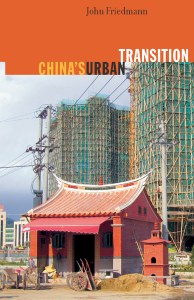
It is only in the past quarter century that urbanization has emerged in China as a force of social transformation while a massive population shift from country to city has brought about a dramatic revolution in China's culture, politics, and economy. China's Urban Transition synthesizes research to provide the first integrated treatment of the processes that encompass the meaning of urbanization.
John Friedmann captures the most profound aspects of China's stunning urbanization and makes sense of its world-historic importance.
Fulong Wu, editor of Globalization and the Chinese City
Though China’s urban history reaches back over five thousand years, it is only in the past quarter century that urbanization has emerged as a force of widespread social transformation while a massive population shift from country to city has brought about a dramatic revolution in China’s culture, politics, and economy. Employing a historical perspective, John Friedmann presents a succinct, readable account and interpretation of how this transition—one of the most momentous phenomena in contemporary history—has occurred.
China’s Urban Transition synthesizes a broad array of research to provide the first integrated treatment of the many processes that encompass the multilayered meaning of urbanization: regional policy, the upsurge of rural industries, migration, expanding spheres of personal autonomy, and the governance of city building. John Friedmann’s detailed analysis suggests that the nation’s economic development has been driven more by social forces from within than by global capital. This leads directly to the epic story of rural migration to major urban regions, the policies used to restrain and direct this “avalanche” of humanity on the move, and the return of many migrants to their home communities, where the process of urbanization continues. Focusing on everyday life in cities, the author also shows how this social transformation extends to the most intimate spheres of people’s lives. In conclusion, he raises the question of a “sustainable” urban development and its relation with China’s own past, values, and institutions.
Friedmann predicts that within ten years China—already the most powerful country in East Asia—will have become a major power in the world. With historical depth, interpretive insight, and interdisciplinary breadth, this book offers an unparalleled introduction to China’s transformation.
John Friedmann captures the most profound aspects of China's stunning urbanization and makes sense of its world-historic importance.
Fulong Wu, editor of Globalization and the Chinese City
This is an extremely timely publication that clarifies the web of forces and players involved in China's dramatic urban transition without forgetting the historical backdrop peculiar to this vast country with a long history of urban experience.
Heng Chye Kiang, National University of Singapore
This book has opened up an important debate.
Urban Studies Journal
Timely and thought-provoking. This book deftly captures the most essential aspects of urban transition in China and traces its connection with history, traditional values, and institutional evolution. This book not only helps students, scholars, and people outside China’s borders to understand China’s urbanism, but also stimulates the ‘China specialists’ to ponder about the connection between China’s own development trajectory and today’s stunning urban transition beyond the explicatory effects of globalization.
China Information
A succinct and compelling story of China’s stunning process of urbanization in the post-Mao era. Highly recommended.
Choice
This is a balanced, highly-well-informed, and extremely readable book that I would heartily recommend for a novice who wants a quick and insightful look at today’s People’s Republic.
Journal of Planning Education and Research
It summarizes the relevant English-language literature on China’s urbanization and offers a multilayered story of China’s accelerated urbanization during the post-Mao era. There is little doubt that John Friedmann has made an important contribution to the growing literature on this topic. He has done an excellent job in synthesizing a wide range of research and combining it with the integrated treatment of China’s urban transformation process.
Environment and Planning A
The slim volume is fast-paced and well-written, and seeks succinctly to traverse a wide range of issues related to urbanization processes whilst providing clear and basic definitions for most of the phenomena he encounters along the way.
China Journal
Overall, the book is an articulate and holistic treatment of contemporary urban China. The book also has strength in that it gives the reader a sense of the multifaceted nature of China’s urban transition.
Social and Cultural Geography
John Friedmann displays an amazing ability in synthesizing and integrating pertinent aspects of the most exciting and rapid urbanization processes of an ancient civilization.
disP
John Friedmann, a well-known, retired UCLA urban and regional planner, wrote this book for the people he represents: intelligent, interested nonspecialists. He succeeds admirably with an amply illustrated volume of 128 accompanied by copious notes and references revealing his academic background.
Economic Geography
China’s Urban Transition is ambitious, well conceived and well written. It is an insightful and scholarly review of a substantial body of literature.
Canadian Journal of Urban Research
Contents
Preface
Introduction: Becoming Urban in China
1. Historical Traces
2. Regional Policies
3. Urbanization of the Countryside
4. New Spatial Mobilities
5. Expanding Spaces of Personal Autonomy
6. The Governance of City-Building
Conclusion: Backward into the Future
Notes
References
Index