In the Scheme of Things
Alternative Thinking on the Practice of Architecture
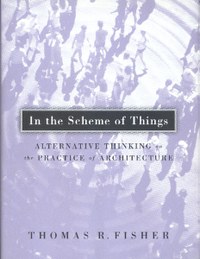
In the Scheme of Things looks at architecture’s need to respond creatively and meaningfully to the extraordinary changes affecting the profession now. In each of the twelve essays that comprise this timely volume, Fisher addresses issues of vital concern to architects and students, offering hard-hitting criticism and proposing innovative and practical ideas for reform at the level of both the individual practitioner and the profession as a whole.
The forms of architectural practice and the education of architects are all too rarely scrutinized. This book seeks to address the oversight. Modest, carefully written, and refreshingly jargon-free, it connects those issues and considers them primarily in the context of North America to present a claim that architecture is in a state of crisis.
Azure

At the dawn of the twenty-first century, architecture is in a state of crisis. Numbed by an ugly and shoddily constructed built environment and outraged by the cost of high-profile design projects, the public has become disinterested in and contemptuous of architecture as both a profession and an art. At the same time, some of our most creative designers have isolated themselves from the tastes and needs of mainstream society, reflecting a similar malaise found in design and architecture schools around the country. In this troubling climate, Thomas R. Fisher—who challenged architects as editorial director of Progressive Architecture, becoming recognized as one of the field’s most original thinkers—contends that the purpose and prospects of architectural practice must be reconsidered and reenergized. In the Scheme of Things looks at architecture’s need to respond creatively and meaningfully to the extraordinary changes affecting the profession now, changes that include the global economy, the advent of computer-aided design, and the growing disconnection between design schools, architectural practice, and the public.
In each of the twelve essays that comprise this timely volume, Fisher addresses issues of vital concern to architects and students, offering hard-hitting criticism and proposing innovative and practical ideas for reform at the level of both the individual practitioner and the profession as a whole. Through his thoughtful and nuanced consideration of architecture’s ideological foundations and its relationship to ecology, politics, and technology, as well as his subtle understanding of the architect’s interior life, Fisher challenges the demoralized design community to recapture its historical role as steward and visionary of the public realm.
The forms of architectural practice and the education of architects are all too rarely scrutinized. This book seeks to address the oversight. Modest, carefully written, and refreshingly jargon-free, it connects those issues and considers them primarily in the context of North America to present a claim that architecture is in a state of crisis.
Azure
The former editor of Progressive Architecture muses on the troubled state of contemporary architectural practice. In twelve loosely related essays, Fisher, long recognized as one of the profession’s keenest critics, warns architects that they risk an increasingly marginalized role within the building industry if they continue business as usual. His sweeping vision calls for reforming professional education, revitalizing relationships among colleagues and with clients, and redefining the design process itself.
Library Journal
Those who think that present-day architecture is ‘numbed by an ugly and shoddily constructed built environment’ are encouraged to read Thomas R. Fisher’s In the Scheme of Things. Twelve essays chart vital concerns in ecology, politics, and technology and reassess the way architects need to think of themselves, concluding that instead of demoralized, cubicle-based plan-manufacturers, they should reinvent themselves as stewards and visionaries of the public realm. Often provocative, this book is full of ideas that, if implemented, might vastly improve the way we live now, judging from the author’s previous essays.
Art Newspaper
Fisher explores the relationship between architecture and society as developments such as computer-based design and a global economy influence the way people view the world around them.
Minnesota Monthly
The purpose and prospects of architectural practice must be reconsidered and renergized, argues Thomas Fisher in his new book, In the Scheme of Things. In a series of twelve essays, Fisher examines the intellectual roots of design culture and addresses issues of vital concern to practicing architects and architecture students, including ethics, multiculturalism, the need to bridge education and practice, and architect as ‘commodity’ and ‘fetish.’ As he critiques, Fisher also proposes innovative and practical ideas for reforming individual practice, as well as the whole profession. Through thoughtful consideration of architecture’s ideological foundations and its relationships to ecology, politics and technology, Fisher challenges what he considers a demoralized design community to recapture its historical role as a steward and visionary of the public realm.
Architecture Minnesota
Content
Acknowledgments
1 Design in a World of Flows
In a world with little respect for traditional structures,
almost everything—from the operation of a company
to the organization of a community—can be approached
as a design problem.
13 Monocultures and Multiculturalism
Ecology teaches us that if we are to encourage more
diverse communities, we must find ways these can evolve
in small increments with minimal overarching design.
27 The Value and Values of Architecture
As architects, our inability to prove our value or articulate
our values has a lot to do with the marginalization of the
profession, yet the addressing of values is the very stuff of
architecture.
39 The Architect as a Social Hieroglyphic
Architects seem destined to become either interchangeable
commodities or the object of fetishes. The Eameses offer a
still-viable model of how to resist both fates.
51 The Fictions of Architecture
To survive as a profession, architecture must be about
more than keeping the water out. Through public fictions,
architects construct the public realm.
67 Critiquing the Design Culture
It is necessary to look at the intellectual roots of the design
culture before contemplating ways it might be reformed.
79 Architectural Fables
Tales of the foxes and hedgehogs among us, with morals for
great fish and small fry.
91 The Redesign of Practice
By defining both design and practice in the narrowest terms,
we limit the application of our knowledge and the influence
of our discipline.
103 Babel Revisited
George Steiner observed that most disciplines use language
to build walls, rather than communicate. In our field, those
supposedly served by jargon have begun to suffer for it.
115 Bridging Education and Practice
Some cures for what ails American architecture—poor
compensation, inadequate research, and growing
competition—may be found in remedies used by other
professions, such as medicine.
123 Architecture and Pragmatism
Is architecture ethical? A look at our philosophical roots
suggests that we can make only conditional judgments
related to buildings. But judge we must.
133 Needed: A Conversation about Ethics
Four classical theories of ethics can be used as a framework
to kick off a conversation about some of the dilemmas we
face as a profession.
151 Index