India’s New Middle Class
Democratic Politics in an Era of Economic Reform
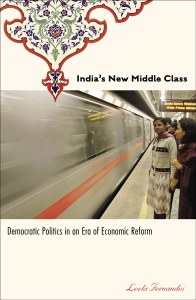
Leela Fernandes digs into the implications of the growth of the middle class in India and uncovers—in the media, in electoral politics, and on the streets of urban neighborhoods—the complex politics of caste, religion, and gender that shape this rising population. Using rich ethnographic data, she reveals how the middle class operates as a proponent of economic democratization.
India's New Middle Class provides a much needed contribution to the literature on India. The book's innovative theoretical insights cast new light not only on the Indian middle class but more generally on the role of the middle class in times of transformation.
Patrick Heller, Brown University
Today India’s middle class numbers more than 250 million people and is growing rapidly. Public reports have focused mainly on the emerging group’s consumer potential, while global views of India’s new economy range from excitement about market prospects to anxieties over outsourcing of service sector jobs. Yet the consequences of India’s economic liberalization and the expansion of the middle class have transformed Indian culture and politics.
In India’s New Middle Class, Leela Fernandes digs into the implications of this growth and uncovers—in the media, in electoral politics, and on the streets of urban neighborhoods—the complex politics of caste, religion, and gender that shape this rising population. Using rich ethnographic data, she reveals how the middle class represents the political construction of a social group and how it operates as a proponent of economic democratization. Delineating the tension between consumer culture and outsourcing, Fernandes also examines the roots of India’s middle class and its employment patterns, including shifting skill sets and labor market restructuring. Through this close look at the country’s recent history and reforms, Fernandes develops an original theoretical approach to the nature of politics and class formation in an era of globalization.
In this sophisticated analysis of the dynamics of an economic and political group in the making, Fernandes moves beyond reductionist images of India’s new middle class to bring to light the group’s social complexity and profound influence on politics in India and beyond.
Fernandes has written a study of the dynamics leading to the emergence of India’s new middle class that makes an important theoretical and substantive contribution to this literature. The book will be of interest to scholars and theorists seeking to understand the origins, character, and political impact of this class. Recommended.
Choice
India's New Middle Class provides a much needed contribution to the literature on India. The book's innovative theoretical insights cast new light not only on the Indian middle class but more generally on the role of the middle class in times of transformation.
Patrick Heller, Brown University
Leela Fernandes deftly uses a sophisticated theoretical framework to explain her rich local-level field evidence that few others could hope to match in terms of empathy, language, and a complete mastery of local knowledge and idioms.
Paul Lubeck
Leela Fernandes has written an impressive and ambitious analysis. Her approach is highly nuanced, consistently reminding the reader of the diversity within middle-class experiences and the variety of practices (discursive, civic, consumption) through which a new normative national standard of a consumer-citizen has been costructed. Fernandes has presented a sophisticated, original and imaginative appraisal of Indian middle-class politics, and why they matter.
Pacific Affairs
India’s New Middle Class is an important book because it gives one an appreciation for the theoretical and empirical complexity involved in defining class in a country like India during this historical moment. It is thus important reading for a sociology of neoliberalism.
Contemporary Sociology
Leela Fernandes’s work makes an important contribution to the study of middle classes in contemporary India, as well as to the field of comparative political economy in general. If for nothing else, the author deserves applause for this insightful peep into the politics of India’s new middle class. Students of development studies will find the study valuable.
Development and Change
Contents
Acknowledgments
Introduction
1. The Historical Roots ofthe New Middle Class
2. Framing the Liberalizing Middle Class
3. Social Capital,Labor Market Restructuring, and India’s New Economy
4. State Power,Urban Space,and Civic Life
5. Liberalization,Democracy,and Middle Class Politics
Conclusion
Notes
Glossary of Acronyms and Indian Terms
Works Cited
Index