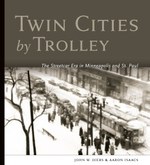
Twin Cities by Trolley
The Streetcar Era in Minneapolis and St. Paul
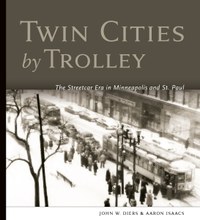
Twin Cities by Trolley offers a rolling snapshot of Minneapolis and St. Paul from the 1880s to the 1950s, when the streetcar system shaped the entire area. More than 400 photographs and 70 maps let the reader follow the tracks from Stillwater to Lake Minnetonka, through Uptown to downtown Minneapolis. The illustrations show nearly every Twin Cities neighborhood as it once was.
Streetcars played a huge role in the making of Minneapolis and St. Paul. Gone for half a century, they remain embedded in our collective memory like the ghostly rails still buried in our streets. Now their full story has at last been told in Twin Cities by Trolley, a book that will cause you to marvel at what we once had and what we have lost.
Larry Millett, author of Lost Twin Cities
The recent development of light rail transit in the Twin Cities has been an undeniable success. Plans for additional lines progress, and our ways of shopping, dining, and commuting are changing dramatically. As we embrace riding the new Hiawatha light rail line, an older era comes to mind—the age when everyone rode the more than 500 miles of track that crisscrossed the Twin Cities.
In Twin Cities by Trolley, John Diers and Aaron Isaacs offer a rolling snapshot of Minneapolis and St. Paul from the 1880s to the 1950s, when the streetcar system shaped the growth and character of the entire metropolitan area. More than 400 photographs and 70 maps let the reader follow the tracks from Stillwater to University Avenue to Lake Minnetonka, through Uptown to downtown Minneapolis. The illustrations show nearly every neighborhood in Minneapolis and St. Paul as it was during the streetcar era.
At its peak in the 1920s and early 1930s, the Twin City Rapid Transit Company (TCRT) operated over 900 streetcars, owned 523 miles of track, and carried more than 200 million passengers annually. Recounting the rise and fall of the TCRT, Twin Cities by Trolley explores the history, organization, and operations of the streetcar system, including life as a streetcar operator and the technology, design, and construction of the cars.
Inspiring fond memories for anyone who grew up in the Twin Cities, Twin Cities by Trolley leads readers on a fascinating and enlightening tour of this bygone era in the neighborhood and the city they call home.
Streetcars played a huge role in the making of Minneapolis and St. Paul. Gone for half a century, they remain embedded in our collective memory like the ghostly rails still buried in our streets. Now their full story has at last been told in Twin Cities by Trolley, a book that will cause you to marvel at what we once had and what we have lost.
Larry Millett, author of Lost Twin Cities
Twin Cities by Trolley is a comprehensive history of the streetcar in the Twin Cities from the end of the nineteenth century until its demise in 1954. This collection of photographs illustrates all phases of the streetcar’s operation and its impact on the development of the Twin Cities.
Hy Berman, Emeritus Professor of History, University of Minnesota
Through readable text, detailed maps, and an assortment of black-and-white photos that's nothing short of impressive, authors Diers and Isaacs illustrate every corner of the system and tell the story of how the Twin Cities Rapid Transit System came to be and how it disappeared. The authors, both employees of the Twin Cities Metropolitan Transit Commission who also rode Twin Cities streetcars as kids, approach the subject without drowning it in nostalgia. This book covers a piece of history that’s repeating itself—with a twist.
Trains Magazine
This gorgeous coffee table book chronicles the rise and fall of that remarkable system with fascinating stories and historical images. This is not simply a comprehensive and compelling chronicle of a bygone way of travel, it’s a remarkable portrait of a city coming of age.
Minneapolis Observer Quarterly
Coffeetable-worthy.
Metro
Twin Cities by Trolley is packed with information, supplemented by more than 400 pictures and 70 maps that follow the tracks as far away as Stillwater and Lake Minnetonka. Besides showing the streetcars including early cars drawn by horses, these wonderful old photos remind us of what St. Paul and Minneapolis looked like before World War II.
St. Paul Pioneer Press
Hardcore transit wonks will want to devour the entire book, and more casual readers will delight in the huge array of photographs. Diers and Isaacs’s book is an excellent background as the region embarks on a new era of transit.
Minnesota Magazine
Recreates the streetcar era in words, maps, charts and more than 400 marvelous photographs. The lavish black-and-white photographs provide an amazing window into the past, in which trolleys were always front and center in the bustling downtowns and the transit company-operated resorts at Minnetonka and White Bear Lake. A large portion of the book is devoted to details on each route, giving readers a chance to look up the streetcars that served their neighborhoods, down to how often they ran. In the end, the streetcars were sunk by Americans’s love of cars, massive spending on highways and the migration to the suburbs. Yet the nostalgia for the streetcar era never faded.
Minneapolis Star Tribune
In Twin Cities by Trolley John W. Diers and Aaron Isaacs, who have both worked in the transit industry for more than 30 years, wax nostalgic about the trolley way of life. Meticulously documenting the trolley years through transit maps of virtually every neighborhood in town, and including more than 400 photographs, the authors reconstruct the era.
City Pages
Diers and Isaacs’s book offers a rolling snapshot from the 1880s to the 1950s, when the streetcar system shaped the growth and character of the entire metropolitan area. Follow the tracks from Stillwater to University Avenue to Lake Minnetonka. Twin Cities by Trolley explores the history, organization and operations of the streetcar system, including life as a streetcar operator and the technology, design and construction of the cars.
St. Croix Valley Press
This detailed account sets the stage for the resurgence of rail.
M Magazine
John W. Diers and Aaron Isaacs’s deep affection for, and knowledge of, this mode of transportation shows in their careful presentation of a myriad of details associated with the technology, politics, work conditions, and geography of the Twin City Rapid Transit System. This wonderful collection invites further research into the impact of streetcars on the architecture, land use, and culture of the Twin Cities and first-ring suburbs. The book is an important and most welcome addition to the growing literature on the Twin Cities.
Minnesota History