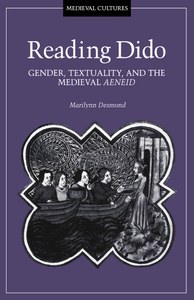
Reading Dido
Gender, Textuality, and the Medieval Aeneid
Marilynn Desmond recovers an alternative Virgil from historical tradition and provides a new model for reading the Aeneid. Following the figure of Dido as she emerges from ancient historical and literary texts and circulates in medieval textual cultures, Reading Dido offers the modern reader a series of countertraditions that support feminist, anti-homophobic, and postcolonial interpretive gestures.
With her focus on the historical reception of Dido, Desmond pioneers the future study of the politics of reading, the social history of readership, and women's self-image in literature. Her careful, comparatist analysis is a model challenge to all readers, from philologists to feminists to cultural critics. In questioning classic assumptions, Reading Dido is destined to become a classic itself.
Earl Jeffrey Richards, comparatist and translator of Christine de Pizan's Book of the City of Ladies
If we view the Aeneid—the poem of empire, conquest, and male hierarchy-as the West's quintessential canonical text and Latin primer, then the history of Virgil readership should tell us much about the concept of education in the West. In this book, Marilynn Desmond reveals how a constructed and mediated tradition of reading Virgil has conditioned various interpretations among readers responding to medieval cultural and literary texts. In particular, she shows how the story of Dido has been marginalized within canonical readings of the Aeneid. Reaching back to the Middle Ages and vernacular poetic readings of Dido, Desmond recovers an alternative Virgil from historical tradition and provides another paradigm for reading the Aeneid.
Desmond follows the figure of Dido as she emerges from ancient historical and literary texts (from Timaeus and Justin to Virgil and Ovid) and circulates in medieval textual cultures. Her study ranges from the pedagogical discourses of Latin textual traditions (including Servius, Augustine, Bernard Silvestris, and John of Salisbury) to the French and English vernacular cultures inscribed in the Roman d'Eneas, the Histoire ancienne jusqu'à César, and the work of Dante, Chaucer, Gavin Douglas, Caxton, and Christine de Pizan. The positions of all these readers point to the cultural specificity and historical contingency of all traditions of reading; thus, this book demonstrates how medieval traditions of reading Dido offer the modern reader a series of countertraditions that support feminist, antihomophobic, and postcolonial interpretive gestures.
With her focus on the historical reception of Dido, Desmond pioneers the future study of the politics of reading, the social history of readership, and women's self-image in literature. Her careful, comparatist analysis is a model challenge to all readers, from philologists to feminists to cultural critics. In questioning classic assumptions, Reading Dido is destined to become a classic itself.
Earl Jeffrey Richards, comparatist and translator of Christine de Pizan's Book of the City of Ladies
Reading Dido is a triumph, an extraordinary achievement in (and for) classical philology, medieval studies, comparative literary analysis, women’s studies, and reception theory. Informed as well by postcolonialism, cultural studies, and film theory, Reading Dido is a feminist analysis of the historical reception of Dido from Virgil’s poetic renegotiation of earlier historical tradition in the Aeneid through Christine de Pizan’s Cite des dames. Reading Dido, while deeply grounded in traditional philology and literary history, paradoxically inscribes an act of radical resistance in pioneering a politics of reading, as well as in offering a preliminary model of ‘feminist self-fashioning’.
Leslie Cahoon, Gettysburg College
Marilynn Desmond’s reading of the medieval Dido is a troubling one, and it strives to be so. From the beginning, Desmond seeks to trouble—to disturb and interrupt—the power structures and gender hierarchies traditionally associated with the reading of the Aeneid IV. Dido’s history—classical, medieval and modern—is a troubled one, which Desmond, in her well-researched, carefully documented and lavishly illustrated study, confronts head on.
Medium Aevum
Her general perspective is framed by feminist theory, which enables her to tease out the shifting dynamics of sexual politics involved in such an intertextual process while providing her readers with valuable conceptual tools culled from the most recent methodological debates.
Studies in Iconography