Aesthetic Theory
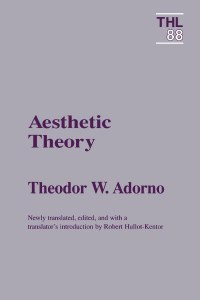
Translated and with a foreword by Robert Hullot-Kentor
Perhaps the most important aesthetics of the twentieth century appears here newly translated, in English that is for the first time faithful to the intricately demanding language of the original German. The culmination of a lifetime of aesthetic investigation, Aesthetic Theory is Adorno’s major work, providing a clarifying lens through which the whole of Adorno’s corpus is best viewed.
Inserting the ‘silver rib of a foreign word’ into an idea, Walter Benjamin argued in a passage Adorno was fond of quoting, helps the idea to survive. Meant to undermine the ideology of an entirely organic language, free of all alien intrusions, this insight can be fruitfully extended to distinguished translations of entire texts. In the case of Adorno’s posthumous magnum opus, Aesthetic Theory, Robert Hullot-Kentor’s long-awaited new translation is pure sterling. Rarely has so much thoughtfulness and sensitivity been marshaled to retranslate a work that fully deserves a second chance.
Martin Jay, University of California, Berkeley
Perhaps the most important aesthetics of the twentieth century appears here newly translated, in English that is for the first time faithful to the intricately demanding language of the original German.
The culmination of a lifetime of aesthetic investigation, Aesthetic Theory is Adorno’s major work, a defense of modernism that is paradoxical in its defense of illusion. In it, Adorno takes up the problem of art in a day when “it goes without saying that nothing concerning art goes without saying.” In the course of his discussion, Adorno revisits such concepts as the sublime, the ugly, and the beautiful, demonstrating that concepts such as these are reservoirs of human experience. These experiences ultimately underlie aesthetics, for in Adorno’s formulation “art is the sedimented history of human misery.”
Robert Hullot-Kentor’s translation painstakingly, yet fluently, reproduces the nuances and particularities of the original. Long awaited and significant, Aesthetic Theory is the clarifying lens through which the whole of Adorno’s work is best viewed, providing a framework within which his other major writings cohere.
Contents
Art, Society, Aesthetics
Situation
On the Categories of the Ugly, the Beautiful, and Technique
Natural Beauty
Art Beauty: Apparition, Spiritualization, Intuitability
Semblance and Expression
Enigmaticalness, Truth Content, Metaphysics
Coherence and Meaning
Subject-Object
Toward a Theory of the Artwork
Universal and Particular
Society
Paralipomena
Theories on the Origin of Art
Awards
A Choice Outstanding Academic Title
Inserting the ‘silver rib of a foreign word’ into an idea, Walter Benjamin argued in a passage Adorno was fond of quoting, helps the idea to survive. Meant to undermine the ideology of an entirely organic language, free of all alien intrusions, this insight can be fruitfully extended to distinguished translations of entire texts. In the case of Adorno’s posthumous magnum opus, Aesthetic Theory, Robert Hullot-Kentor’s long-awaited new translation is pure sterling. Rarely has so much thoughtfulness and sensitivity been marshaled to retranslate a work that fully deserves a second chance.
Martin Jay, University of California, Berkeley
In this new and crisp translation Hullot-Kentor has accomplished a herculean feat in rendering Adorno into English. This is perhaps as close as one can get to Adorno’s hypnotic and enigmatic style. Simply put, Aesthetic Theory is one of the most important philosophical works-and perhaps the most important study of aesthetics-of the 20th century. This fresh and rigorous translation is particularly welcome because Adorno has never been fully understood in America. This is a book one returns to again and again. Highly recommended.
Choice
Now we have an excellent version of the Aesthetic Theory in English.
Philosophy in Review
Aesthetic Theory is Adorno’s late magnum opus and among the most significant works on aesthetics of the twentieth century. It is the highly crafted product of a career dedicated to thinking about art as a crucial feature of modernity. Not only does it rework Adorno’s previous research around new categories-specifically mimesis-but, in an extension of his preoccupation with the problem of philosophical presentation, it offers a radical restructuring of the philosophical text. Most explicitly, Aesthetic Theory is an attempt to establish why and how it is through modern autonomous art that truth and freedom are to be revealed in developed capitalist societies.
Radical Philosophy
Adorno’s Aesthetic Theory, originally published in 1970 and now adroitly translated from the German by Robert Hullot-Kentor, appears at an extremely propitious moment in the development of art history and cultural studies. Adorno’s tract is densely written, yet philosophically expansive, aesthetics, at once negative and positive. Adorno’s text again recalls the writings of some of the authors and composers he like most-Stephane Mallarme, Marcel Proust, James Joyce, Arnold Schoenberg, and Alban Berg. Like them, Adorno rejected strict linearity in thought and motif, preferring instead to construct his compositions by means of circuits of reference, allusion, and repetition. Like their best works, Aesthetic Theory contains the stubborn insight-rarely offered by cultural critics today-that redemption may be glimpsed only by means of the most difficult and determined artistic ciphers of negation.
Art Journal